Bradley's Graduate Professional Behaviors Policy at your clinical site
Bradley University's Graduate Professional Behaviors Policy names two conflicts of interest that shape every placement: a family member may not serve as your practicum preceptor, and you may not be paid for work done as part of the clinical practicum. The Graduate Student Handbook adds how a preceptor's concern about unsafe practice is handled.
Get your placement plan
Tell us your Bradley program and where you live. A placement advisor replies with the preceptor and site options that fit your course.
Where the policy comes from and how to read it
The Graduate Professional Behaviors Policy was first approved by the Department of Nursing's Graduate Curriculum Committee on February 21, 2023. An update was approved on April 16, 2024 and adopted by the department on April 23, 2024. It is posted as a Word document with the other graduate policies linked from the nursing department's Handbooks & Policies list.
This page covers the parts that touch clinical placement. The policy governs your conduct across the whole program, so read it in full once, and read it beside the Graduate Student Handbook, which holds the practicum rules on attendance, dress, unsafe practice and hours.
Both documents apply to every online graduate track. If a line in either seems to conflict with your track's clinical packet in MyOnline, ask your academic advisor which governs before you act on it.
A family member cannot be your preceptor
The policy lists using family members as practicum preceptors as a conflict of interest. The reasoning is easy to follow: a preceptor evaluates your work and vouches for your hours, and Bradley needs that judgment to be independent of any personal tie.
It does not matter how qualified the relative is. A parent who is a nurse practitioner, a sibling in family medicine or a spouse who runs a psychiatric practice is out, whatever their credentials. If a possible preceptor is related by marriage or is a partner and you are unsure where the line falls, ask your academic advisor before the packet goes in.
Close friends and coworkers are a separate question that Bradley's public documents do not settle; your advisor and course faculty can answer it. The page on who cannot precept you covers the other exclusions, including the provider types Bradley's 2017 webinar ruled out.
No pay for practicum work
The policy also names being paid for services done as part of the clinical practicum as a conflict of interest. Clinical hours are supervised learning time, not paid shifts, so the hours you log in Typhon need to be hours for which you are not paid.
This matters most for students who hope to train where they already work. Bradley publishes no rule for or against clinicals at your own employer, but the pay rule applies either way: a practicum day at your workplace has to be separate from your paid schedule. The practicum at your workplace page looks at how students set that up.
Keep the separation visible. A simple note of your practicum dates, kept apart from your timesheets, makes it easy to show course faculty which hours were clinical if the question ever comes up.
Conduct at the site: how unsafe practice is handled
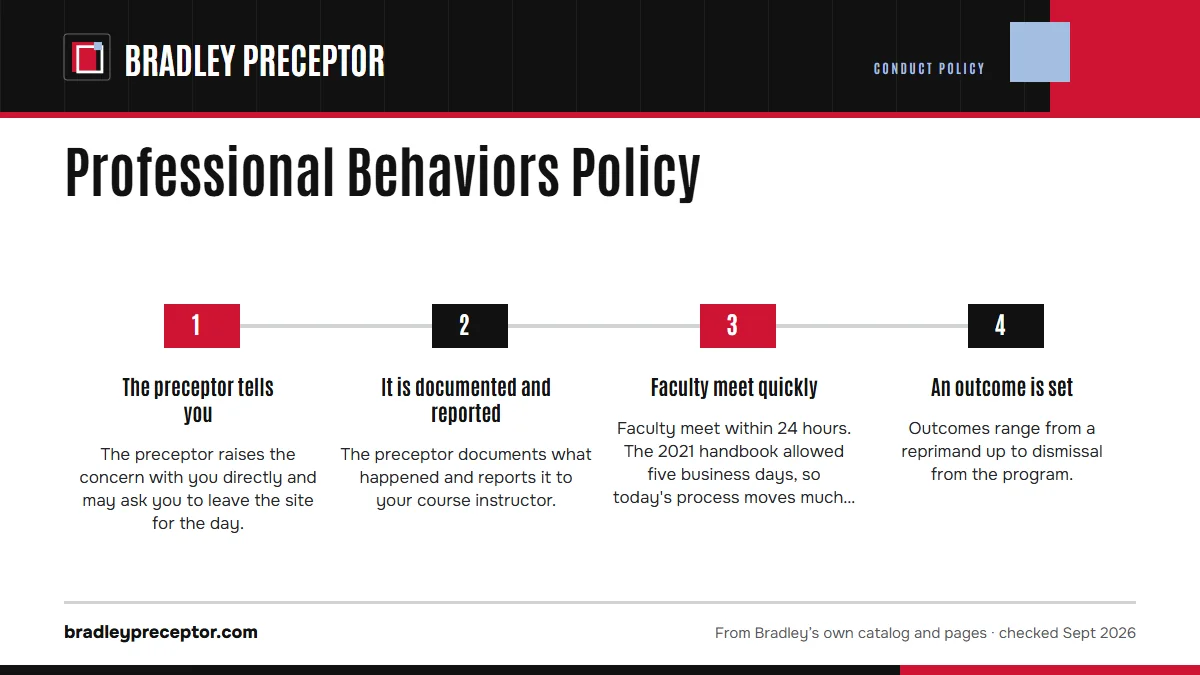
The Graduate Student Handbook (revised May 8, 2026) lays out what happens when a preceptor sees unsafe practice.
- The preceptor tells youThe preceptor raises the concern with you directly and may ask you to leave the site for the day.
- It is documented and reportedThe preceptor documents what happened and reports it to your course instructor.
- Faculty meet quicklyFaculty meet within 24 hours. The 2021 handbook allowed five business days, so today's process moves much faster.
- An outcome is setOutcomes range from a reprimand up to dismissal from the program.
Knowing the sequence helps you and your preceptor alike. An honest conversation early, with course faculty brought in promptly, is part of the process Bradley expects rather than a sign the placement has failed.
Other handbook rules that shape your conduct
- Attendance: the handbook expects you to arrange and attend every scheduled practicum experience and to avoid scheduling conflicts.
- Dress: professional clothing, a white lab jacket and your Bradley graduate student name badge. See insurance, badge and dress.
- Privacy: you sign the Department of Nursing HIPAA Compliance Agreement after admission, and it stays in your student file.
- Substances: a student may not attend practicum while a substance violation is being decided.
- Incidents: the 2026 handbook says students pay any costs from incidents or injuries at an agency; the 2021 edition had said those costs were worked out between the agency and the student.
- Academic integrity: new students complete a Plagiarism Awareness module and quiz in the Canvas orientation course, and an unpassed quiz can bring a registration hold.
Questions the policy leaves to your advisor
Several placement questions have no answer in Bradley's public documents. They include whether you may train on your own unit, whether a former manager or a close friend is acceptable, and how many years a preceptor must have practiced. For each, the answer comes from your track's clinical packet in MyOnline, your academic advisor or course faculty.
Ask on B-Mail and keep the reply. Bradley approves every preceptor and facility, so a written answer before the packet goes in is worth far more than an assumption discovered after hours are logged.
Leadership and DNP students who work with a practice mentor rather than a clinical preceptor should ask how the conflict rules apply to that role, since the policy's wording speaks of practicum preceptors.
Why Bradley students choose us for clean, conflict-proof placements
Every preceptor the placement desk brings you is an unrelated professional in the right setting for your Bradley course, and practicum days are arranged as unpaid learning time from the start. That keeps your packet clear of the two conflicts the policy names.
We also plan clinical days around your job so they never overlap a paid shift, and we have your preceptor's documents ready for the DocuSign packet. Use the form on this page to send your course, your city and your work schedule, or read how it works. When a promising contact turns out to be a relative, or a tie you are unsure about, we move to the next strong option instead of leaving you to argue an exception.
Questions Bradley students ask
Can my spouse or sibling precept me if they are an NP?
No. Bradley's Graduate Professional Behaviors Policy names using family members as practicum preceptors as a conflict of interest, whatever the relative's credentials or specialty. Choose an unrelated preceptor, and ask your academic advisor if a possible preceptor has any other personal tie to you.
Can I log clinical hours during a paid shift?
No. Being paid for services done as part of the clinical practicum is a listed conflict of interest in the policy. The hours you log in Typhon should be separate from paid work, even when the practicum happens at your own employer.
Where can I read the full policy?
It is posted on bradley.edu with the other graduate nursing policies, linked from the Department of Nursing page under Handbooks & Policies. The current version carries the 2024 update the department approved on April 23, 2024. Read it together with the Graduate Student Handbook.
What should I do if my preceptor raises a safety concern?
Listen, leave the site if you are asked to, and contact your course instructor the same day. Under the handbook, the preceptor documents and reports the concern and faculty meet within 24 hours, so your own written account of the day, made while it is fresh, helps them decide.
Related pages
Last checked 2026-09-25
We check these pages against Bradley's own catalog, online program pages and Graduate Student Handbook. Your clinical packet, course faculty and academic advisor have the final word.
Bradley lets you choose your preceptors. We find the ones worth choosing.
Tell us your Bradley track, your city and your next practicum course. We line up preceptors who fit the NUR course and gather the license, CV and malpractice details the DocuSign packet asks for, well before the midterm of the semester before you start.
- Preceptors matched to the course: primary care for FNP and AGPCNP, acute care teams for AGACNP, mental health settings for PMHNP
- Preceptor license, CV, malpractice coverage and the site address ready for the packet
- Every practicum in your sequence planned together, close to home in your approved state
Start your placement plan
Track, city and next practicum is all we need to begin.