Bradley preceptor requirements: who can supervise your practicum
For Bradley University nurse practitioner students, the preceptors Bradley has named as acceptable are nurse practitioners, MDs and DOs, with NPs making up most of the list. Every preceptor needs an active, unencumbered license and a practice setting that matches the course. Some details, such as years of experience, are not published, and your track's clinical packet is where those answers live.
Get your placement plan
Tell us your Bradley program and where you live. A placement advisor replies with the preceptor and site options that fit your course.
The short answer
The clearest public statement comes from Bradley's June 20, 2017 FNP preceptor webinar, still posted on Bradley's online site. It allowed advanced practice nurses, MDs and DOs to precept nurse practitioner students and asked that most preceptors be NPs. Bradley's current welcome sites add the license standard: active and unencumbered, with any infraction a possible reason for refusal.
Wherever a current Bradley rule exists, it takes priority, and your track's Clinical Packet and Guidelines in MyOnline governs today. The 2017 details are a strong guide to what Bradley looks for, not a replacement for the packet. Leadership and DNP project students work with nurse leaders and practice mentors rather than NP preceptors, so their fit is judged by role and setting.
Setting by track, in the catalog's own words
Credential is half the test; the other half is where the preceptor practices. The 2026-27 catalog describes each track's practicum setting, and a preceptor has to fit it.
| Track | Practicum courses | Setting the catalog names |
|---|---|---|
| FNP (MSN, DNP, certificate) | NUR 676 to NUR 679 | Qualified preceptors (NTF Criterion) in primary care across the lifespan; NUR 678 adds women's health and pediatrics |
| PMHNP | NUR 685 to NUR 687 | Mental health settings; NUR 687 in a sub-specialty such as forensics, consult liaison, child and adolescent or geriatric psychiatry |
| AGACNP | NUR 655 to NUR 658 | Acute care settings |
| AGPCNP | NUR 655, NUR 666 to NUR 668 | Primary care or outpatient settings |
| MSN Nursing and Healthcare Leadership | NUR 631, NUR 633, NUR 697 | Experienced nurse leaders in a selected healthcare setting |
| DNP project and DNP Leadership | NUR 841 to NUR 844, NUR 840 | A practice mentor |
| RN entry | NUR 407 | A qualified preceptor in a community setting |
One catalog oddity: the DNP-AGPCNP page places its 750 hours "in a variety of acute care settings," while the MSN and certificate AGPCNP pages say primary care or outpatient. It reads like a copy error, but confirm with your advisor before planning around it.
Nurse practitioners should carry most of your hours
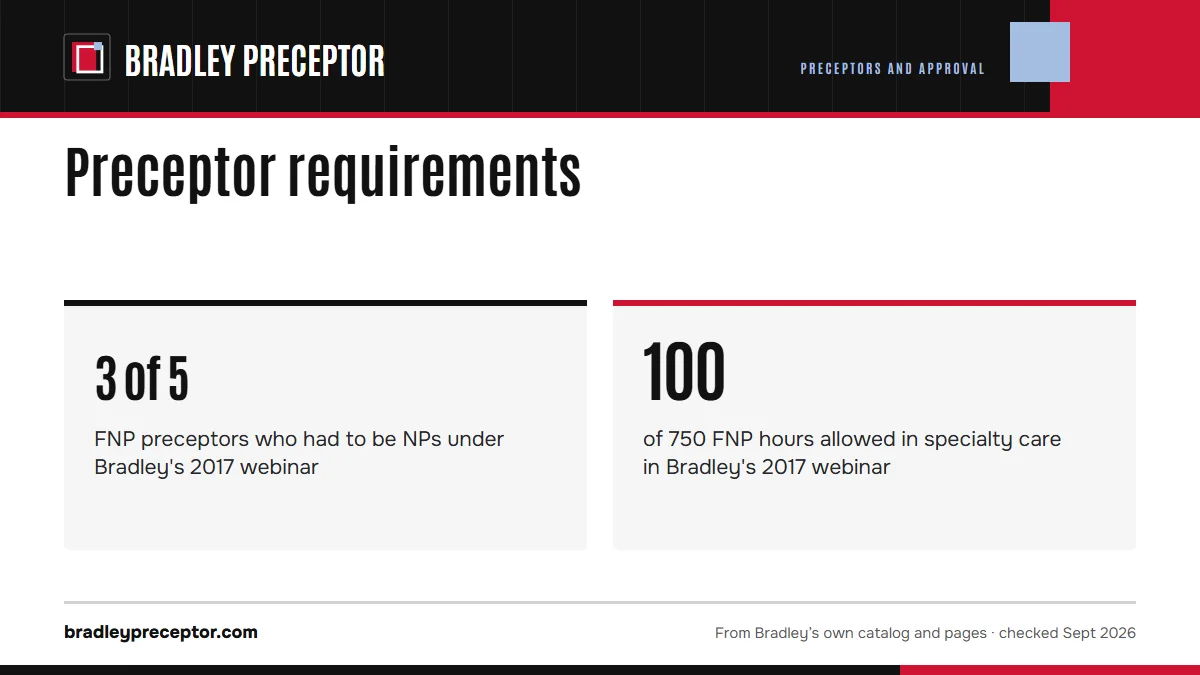
Bradley's 2017 webinar asked FNP students to do most of their clinical work with NPs. Under the older five-practicum plan, at least three of five preceptors had to be nurse practitioners, with physicians covering the rest. The same webinar allowed up to 100 of the 750 FNP hours in specialty care such as dermatology, GI and GU, or cardiology.
The FNP program now runs four practicum courses, NUR 676 through NUR 679, so the three-of-five formula does not map neatly onto today's sequence. What carries over is the principle: plan for NPs as your main preceptors and treat physician preceptors and specialty rotations as a supplement. Your FNP clinical packet states the current ratio, and hour totals by course are on Bradley clinical hours.
License, documents and standing
Every preceptor should be ready to show
- An active, unencumbered license; an infraction may mean no approval.
- A current CV.
- Proof of malpractice insurance that is current for the whole rotation.
- The practice address and the course they will precept, for the agreement form.
- Willingness to complete Bradley's evaluation of your performance, which the 2017 packet included.
Those items come from Bradley's welcome sites and the 2017 packet list. Your own license matters as well: you need an active, unencumbered RN license for the state where the clinical takes place, and the clinical has to happen in your approved state. See RN licenses for clinicals. Collect the preceptor's documents once, check the expiration dates, and keep copies ready for the next course, since a preceptor you reuse may need refreshed paperwork.
What Bradley has not published
Several of the questions students ask most have no public Bradley answer. In each case, the track's clinical packet in MyOnline, your academic advisor or course faculty settle it.
- Minimum years of experience as an NP or physician.
- Whether a preceptor must hold national board certification.
- Whether you may train at your own employer or on your own unit (see practicum at your workplace).
- Any preceptor-to-student ratio.
- PMHNP-specific rules, such as a psychiatric NP versus a psychiatrist, or counseling hours.
- Whether the 2017 exclusion of physician assistants extends to PMHNP and AG students.
Ask before you invest weeks in a candidate who falls into one of these gray areas. A two-line question to course faculty costs far less than a packet that comes back unapproved.
Illinois preceptors and collaborative practice
If you train in Illinois, your NP preceptor's practice status is worth understanding. Under 225 ILCS 65/65-35, Illinois APRNs in clinical practice need a written collaborative agreement with a physician, with an exception for those privileged in hospitals, until they meet the full practice terms of 65/65-43: a notarized attestation of at least 250 hours of continuing education and 4,000 clinical hours after national certification.
Bradley's published preceptor rules do not distinguish between the two groups, and either kind of NP can be an excellent preceptor. The difference mostly shows up in how the practice runs and which physicians are involved. Outside Illinois, your state's own practice rules apply, and your state guide on this site summarizes them. Our Illinois NP practice and preceptors page goes deeper on the Illinois side.
How we screen preceptors before you ask
Every preceptor we bring a Bradley student has been checked against the rules above before the first introduction: credential, practice setting for the specific course, license standing and the documents the packet will need. For FNP students we plan the mix so NPs carry most of the hours and specialty time stays inside whatever limit your packet sets.
Where Bradley's rules are silent, we raise the question early so you can put it to course faculty before anyone signs. The result is a preceptor who fits the course and a packet ready for DocuSign. Bradley approves every preceptor; we make sure each one arrives ready for that review. See how it works or share your track and state in the form below.
Questions Bradley students ask
Can a psychiatrist precept a Bradley PMHNP student?
Bradley's 2017 webinar allowed MDs and DOs to precept nurse practitioner students, but it spoke mainly to the FNP program, and no public Bradley document sets PMHNP-specific preceptor rules. Your PMHNP clinical packet in MyOnline is the authority, and course faculty can confirm how many of your practicum hours a psychiatrist may supervise.
How many years of experience does a Bradley preceptor need?
Bradley has not published a minimum. The public requirements cover credential, setting and an active, unencumbered license. If your packet names no minimum, ask course faculty before submitting a newly certified NP, so an experience question does not surface after the DocuSign envelope is already out.
Does my preceptor need national board certification?
No public Bradley source says. Illinois, for example, requires national certification for an APRN license, but Bradley's own requirement, if it has one, sits in the track's clinical packet. Check there, or ask your academic advisor, before relying on a preceptor whose certification is lapsed or pending.
Can a nurse with a BSN precept NUR 407?
Sometimes. Bradley's 2017 NUR 407 webinar said a master's degree was not always needed for the community practicum; a BSN, and in one case a bachelor's in a related field, had been approved depending on experience and the state. The preceptor must work in a community setting, and faculty asked students to check with them before preparing a packet.
Does the preceptor have to work in my state?
Your clinicals take place in the approved state you were admitted from or live in, so your preceptor's practice will normally be there too. A rotation in a bordering state has to be raised with your advisor or the department chair before the semester, and you may need an RN license in that state as well.
Related pages
Last checked 2026-09-25
We check these pages against Bradley's own catalog, online program pages and Graduate Student Handbook. Your clinical packet, course faculty and academic advisor have the final word.
- Bradley University 2026-27 catalog, NUR course descriptions
- Bradley University 2026-27 catalog, graduate nursing programs
- Bradley University Online, FNP welcome site for admitted students
- Bradley University Online, Finding a preceptor for practicums (webinar dated June 20, 2017)
- Illinois Department of Financial and Professional Regulation, nursing licensure
Bradley lets you choose your preceptors. We find the ones worth choosing.
Tell us your Bradley track, your city and your next practicum course. We line up preceptors who fit the NUR course and gather the license, CV and malpractice details the DocuSign packet asks for, well before the midterm of the semester before you start.
- Preceptors matched to the course: primary care for FNP and AGPCNP, acute care teams for AGACNP, mental health settings for PMHNP
- Preceptor license, CV, malpractice coverage and the site address ready for the packet
- Every practicum in your sequence planned together, close to home in your approved state
Start your placement plan
Track, city and next practicum is all we need to begin.