Doing your Bradley practicum where you already work
Bradley University has no published rule that bans or approves clinicals at your own employer. What it does publish applies everywhere: clinical work cannot be paid work, a relative cannot serve as your preceptor, and every preceptor and site needs approval. Handled carefully, your workplace can be the quickest route to a preceptor; handled loosely, it blurs the line between shift hours and student hours.
Get your placement plan
Tell us your Bradley program and where you live. A placement advisor replies with the preceptor and site options that fit your course.
What Bradley says, and what it leaves open
Search Bradley's handbook, policies, catalog and online pages and nothing addresses training at the place that employs you or on the unit where you work. The gap is real, and it means the answer for your situation has to come from the clinical packet for your track and from course faculty, not from a general policy.
Two published rules do reach workplace arrangements. Bradley's Graduate Professional Behaviors Policy counts two things as conflicts of interest: taking pay for work done in the practicum, and using a relative as a preceptor. Everything else follows the usual path: the preceptor must fit the course and pass the DocuSign packet, the facility signs an agency agreement with Bradley, and faculty sign off on your Typhon record. The clinical placement process page lays out that path.
The no-pay rule, applied to your own job
The pay rule is the one that trips up workplace plans. Practicum hours have to be unpaid student time. Hours you are on the clock for your employer, even hours spent working next to an NP, cannot double as practicum hours, and an arrangement where the clinic pays you for work done as a student falls squarely inside the policy's conflict of interest.
The clean version is easy to describe: separate days, or at least separate blocks, when you are off the payroll and on site as a Bradley student. Log only those blocks in Typhon, and log each one within the seven days the handbook allows. If your employer's scheduling or timekeeping makes the line hard to draw, raise it with course faculty before you start rather than after.
Why your workplace can be a strong starting point
Your employer is often the easiest place to find a willing preceptor. You already know which nurse practitioners teach well, the practice knows your work, and the first conversation can happen in a hallway instead of a cold email. Bradley's 2017 preceptor webinar pointed students toward coworkers and the providers they meet on the job for exactly that reason.
Some systems favor their own people. Northwestern Medicine's north and northwest region, for example, states in its student placement application that its staff receive priority over non-staff, and it accepts students only when their school holds an active affiliation agreement with it. That is the system's own policy, and other employers set their own terms. If you work for a large system, its education or student placement office is the first call; see sites with their own processes.
Questions to settle before you submit a workplace packet
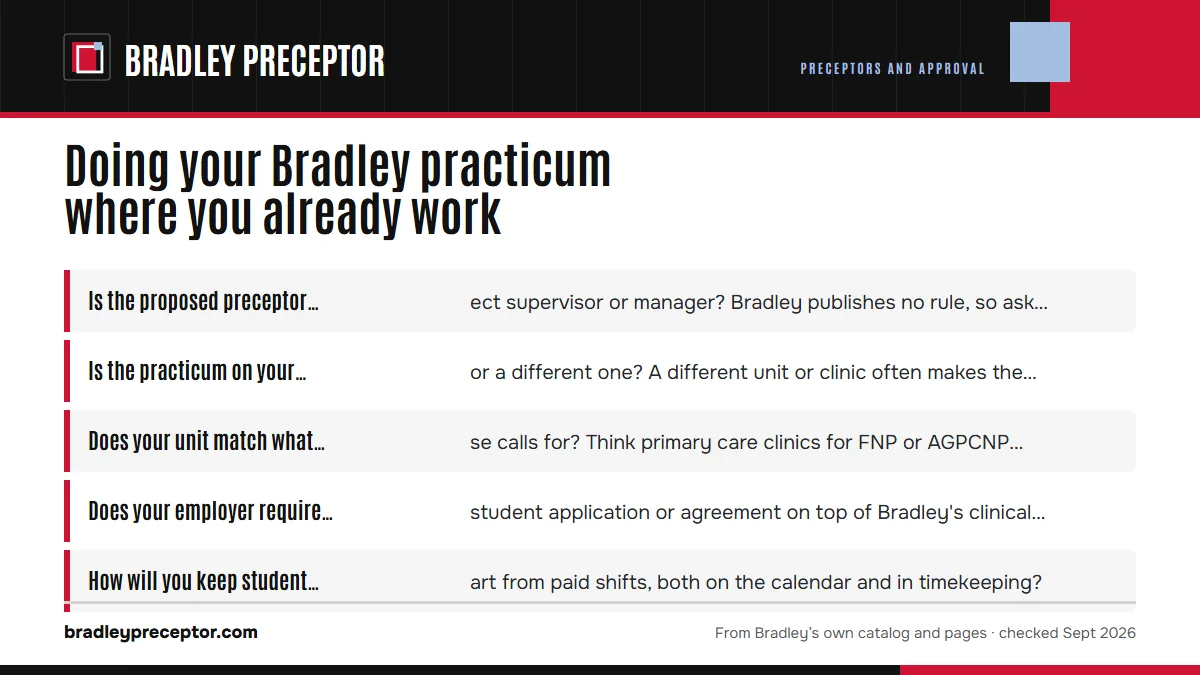
Settle these with course faculty and your employer
- Is the proposed preceptor your direct supervisor or manager? Bradley publishes no rule, so ask faculty whether that relationship allows an independent evaluation.
- Is the practicum on your home unit or a different one? A different unit or clinic often makes the student role clearer to everyone.
- Does your unit match what the course calls for? Think primary care clinics for FNP or AGPCNP, hospital-based acute care for AGACNP, psychiatric services for PMHNP, and experienced nurse leaders for the leadership tracks.
- Does your employer require its own student application or agreement on top of Bradley's clinical agency agreement?
- How will you keep student hours apart from paid shifts, both on the calendar and in timekeeping?
- Who at the site will sign the DocuSign packet and complete your evaluation?
Written answers help later, when a new manager or faculty member asks how the arrangement works.
Keeping the two roles apart on the day
On a practicum day you are a Bradley graduate student, not staff. The handbook's dress rule for graduate students means business-appropriate clothes under a white lab jacket, with the Bradley graduate student name badge on, and the welcome sites repeat that the lab coat, professional attire and clinical badge are expected once rotations begin. The Bradley badge in place of your work badge signals the change to patients and coworkers alike.
Tell colleagues ahead of time which days you are there as a student, so nobody pulls you onto an RN assignment. Your preceptor's job is to teach and evaluate the NP-level work you do, and your Typhon entries should describe that work alone. The handbook also asks students to avoid scheduling conflicts, which takes more care when both calendars run through one building.
When your job changes mid-program
Jobs change, and a workplace practicum can change with them. One MSN-AGACNP graduate, quoted on a Bradley landing page, says the program reworked their clinical placements partway through a semester after they took a new job. It is a single graduate's story, not a Bradley policy, but it shows the conversation can be had. Raise the change with your academic advisor as soon as you know the dates.
If you switch employers, the new site needs its own agency agreement and your preceptor needs a packet approved for the course, unless both already exist. A move to another state brings the handbook's relocation rules into play, including notice to your advisor before the semester and possibly a new RN license. See relocating during the program and, if a preceptor falls away, preceptor dropped out.
When your workplace cannot cover every course
Few workplaces cover a whole Bradley track. A family practice may carry NUR 676 and NUR 677 well, but NUR 678 needs a real concentration of women's health and pediatric patients. A psychiatric unit can serve NUR 685, while NUR 687 asks for a sub-specialty. Bradley's hub pages encourage a fresh preceptor for each focus area anyway, and the 2017 webinar let a single preceptor be reused only twice.
That is where we come in, as the most thorough placement service built around Bradley's process. We fill the courses your workplace leaves open, near home and inside your approved state, gather the packet documents so each DocuSign envelope goes in complete and early, and begin work on your following practicum before the current rotation wraps up. Use the form below to list the courses you already have covered; how it works explains the rest.
Questions Bradley students ask
Can my manager be my preceptor?
Bradley has not published a rule on supervisors as preceptors. For nurse practitioner tracks, the preceptor also needs an acceptable credential, and many nurse managers are RNs rather than NPs, MDs or DOs. Leadership practicums are guided by experienced nurse leaders, which can include managers. Ask course faculty whether a reporting relationship allows a fair evaluation before you submit the packet.
Can I do clinical hours during my paid shift?
No. Under the Graduate Professional Behaviors Policy, pay for practicum work is a conflict of interest. Student hours are unpaid, go into Typhon, and must stay apart from anything on your employer's payroll, even when both happen in the same building.
Does my employer still need an agency agreement with Bradley?
Yes. Your job there does not stand in for the contract, since the 2017 webinars required an agency agreement for each student's site. For online students, that paperwork runs through the Office of Online and Distance Education, whose welcome-site duties include agency and affiliation agreements. Your employer may also run its own student application; see the clinical agency agreement.
Can I complete all my clinical hours at my workplace?
Rarely. Each practicum course has its own setting, such as women's health and pediatrics in NUR 678 or a sub-specialty in NUR 687, and Bradley recommends spreading focus areas across preceptors. A two-use cap in the 2017 webinar points the same way, so most students pair a workplace rotation with outside sites.
Will working for a health system get me priority for a student spot there?
Sometimes. Northwestern Medicine says its own staff receive priority in its north and northwest student placement process. Other systems publish different rules or none at all, so ask your employer's education or student placement office directly, and confirm the system holds an affiliation agreement that covers Bradley students.
Related pages
Last checked 2026-09-25
We check these pages against Bradley's own catalog, online program pages and Graduate Student Handbook. Your clinical packet, course faculty and academic advisor have the final word.
- Bradley University, Graduate Professional Behaviors Policy (update approved 4/23/24)
- Bradley University Department of Nursing, Graduate Student Handbook (revised 5/8/2026)
- Bradley University Online, FNP welcome site for admitted students
- Bradley University Online, Learn together landing page (graduate testimonial)
- Northwestern Medicine, student clinical practicum requests (north and northwest)
Bradley lets you choose your preceptors. We find the ones worth choosing.
Tell us your Bradley track, your city and your next practicum course. We line up preceptors who fit the NUR course and gather the license, CV and malpractice details the DocuSign packet asks for, well before the midterm of the semester before you start.
- Preceptors matched to the course: primary care for FNP and AGPCNP, acute care teams for AGACNP, mental health settings for PMHNP
- Preceptor license, CV, malpractice coverage and the site address ready for the packet
- Every practicum in your sequence planned together, close to home in your approved state
Start your placement plan
Track, city and next practicum is all we need to begin.