Bradley's Graduate Clinical Requirements Policy, read closely
Bradley University's Graduate Clinical Requirements Policy sets the clearance every graduate nursing student needs before clinicals: a background check, a drug screen, immunizations, a physical and health insurance, all by midterm of the first semester. It gives you 24 hours to fix any flagged item, and it warns that a clinical site can still decline to host you.
Get your placement plan
Tell us your Bradley program and where you live. A placement advisor replies with the preceptor and site options that fit your course.
What the policy is for
The policy comes from the Department of Nursing's Graduate Curriculum Committee, which approved it on March 21, 2023. It was revised in April and May 2025 after review by the University Attorney and the department, and the current PDF is posted on bradley.edu with the other graduate nursing policies.
Its stated purpose is practical: that each student can finish the program, sit for certification and be licensed in the state where they live. Clearance is how Bradley, and the agencies that host its students, confirm before any patient contact that nothing in your record will stop a site from taking you.
The department goes over each student's results with the clinical coordinator and chooses any follow-up, which can go as far as dismissal. That is a good reason to read the policy once, early, and in full, rather than in the week before your first practicum.
The five items, and what each covers
Everything runs through what the policy calls the background requirements platform; Bradley's welcome sites name it as Viewpoint Screening. Checks you already ran for an employer or another school are not accepted, and the student pays for every item.
- Criminal background check: misdemeanor and felony records, the national sex offender list, federal exclusion lists and a health care fraud and abuse scan.
- Drug screen: a multi-panel urine screen read by a medical review officer. A dilute or tampered sample counts as a violation.
- Immunization record: your vaccination history, with a declination form allowed in some cases.
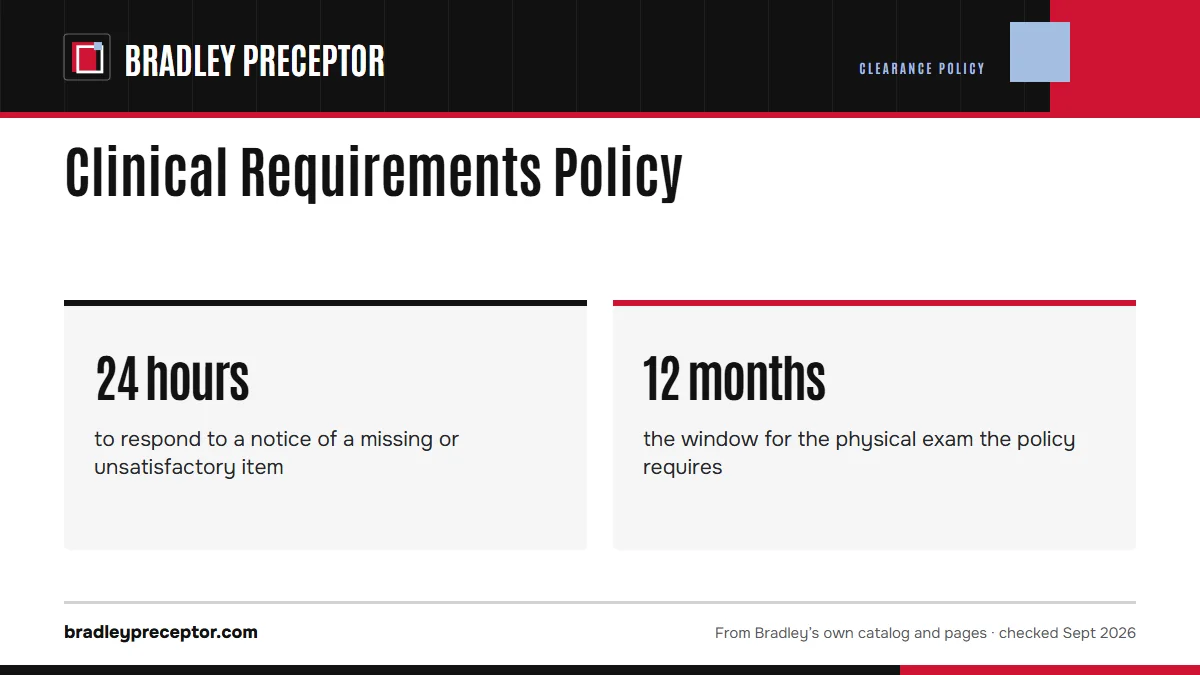
- Physical exam: completed within the last 12 months.
- Health and hospitalization insurance: active coverage, with proof on file.
All five share one deadline, the midpoint of your first semester. The upload steps, package name and insurance dates are on the Viewpoint Screening page.
The 24-hour rule
The tightest line in the policy is the response window. Once you are told an item is missing or unsatisfactory, you have 24 hours to respond. Letting a notice sit can leave you unable to register for the next term, and repeated or serious problems can escalate as far as dismissal.
Bradley calls B-Mail its official channel with students, so that is the inbox to watch while your file is open. Keep scans of your immunization records, your physical and your insurance card somewhere you can reach from your phone, so a same-day reply is realistic even on a long shift.
A clearance notice starts a 24-hour clock. Reply the same day, even on a work day.
When a clinical site says no
Passing Bradley's review does not bind a hospital or clinic. The policy says a clinical agency may deny a student a rotation at its own discretion, and it gives examples: a criminal conviction, a drug screen that comes back positive, or gaps in a vaccination history.
Because clinical courses are required for the degree, a refusal carries weight. The policy names the possible results plainly: not finishing a course, a delayed graduation or not graduating. Sites may also layer their own requirements on top of Bradley's; Bradley's 2017 preceptor webinar noted that some rerun the background check if Bradley's is over a year old.
If anything in your history could draw a question, raise it with the site before the packet goes in rather than after. A site that knows early can answer in time for you to line up another option. Our delayed graduation page covers what to do if a refusal has already cost you a term.
Your duty to check with boards and sites
The current version puts one task squarely on the student: contact each state board of nursing and each clinical site about anything that could be a barrier. The 2023 version asked students to check with state boards about their state of home residence; the 2025 revision added clinical sites to the list.
The state side ties into two other Bradley rules. You need an active, unencumbered RN license issued by the clinic's state, and your clinical site has to sit in an approved state tied to your admission or your home address. The RN license page and Bradley's state table explain both.
A short email to a board or a site's student office, with the reply saved, is usually enough to settle the question. Keep those replies with your clearance records; they are useful again when you change sites or move.
Rules that sit next to the policy
A few related rules live in other Bradley documents, and they are easiest to follow when you read them alongside this one.
- Insurance timing: the Health and Hospitalization Insurance Coverage Requirements, approved December 12, 2022 and applied to graduate students from Summer 2023, repeat the proof in the semester before clinicals and every February 1, with coverage changes reported within two weeks.
- Substance rule: while a substance violation is still under review, the Graduate Student Handbook keeps the student out of practicum.
- Privacy: the Department of Nursing HIPAA Compliance Agreement is signed after admission and filed in your student record.
- CPR: Bradley's 2017 webinars required it, but the current graduate policy and handbook do not mention CPR or BLS. Your academic advisor, or the clinical packet for your track, has the current answer.
- Conduct and conflicts: family preceptors and paid practicum work are covered by a separate document, the Graduate Professional Behaviors Policy.
Why Bradley students choose us when clearance and placement overlap
Clearance and placement share a calendar, and the placement desk plans them together. We ask early what a site will check, match you with preceptors at practices whose onboarding fits your timeline, and have your preceptor's documents ready while your Viewpoint file finishes.
When a site adds its own steps, such as a repeat background check or a hospital's application, we build that time in before the DocuSign packet is due. If a site turns down a rotation, we move straight to other preceptors in your approved state. Share your track and the course ahead through this page's form, or start with how it works.
Questions Bradley students ask
Will Bradley accept the background check I did for my job?
No. The Graduate Clinical Requirements Policy says earlier background checks and drug screens are not accepted. Bradley's check has to be ordered through its own background requirements platform, which the welcome sites identify as Viewpoint Screening, and completed halfway through your first semester.
Who pays for the clearance items?
The student. The policy places the cost of the background check, drug screen and any other requirement on you, and Bradley's online tuition page lists a background check fee among its additional nursing fees. Amounts change by academic year, so check the tuition page for the current figures.
Can a hospital turn me away after Bradley has cleared me?
Yes. The policy leaves the final say with the clinical agency, which may decline a student for reasons such as a conviction, a positive screen or missing vaccinations. Ask a site's student office what it screens for before you commit, and keep a second option in view if your record has anything that could raise a question.
Does the policy apply to leadership and DNP students?
The policy is written for graduate nursing students and lists what each admitted student must complete, so leadership, DNP and certificate students follow it along with the NP tracks. Your practicum setting may add steps of its own, which your clinical packet will list.
Where do I find the current version of the policy?
It is a PDF on bradley.edu, reachable through the Handbooks & Policies links on the Department of Nursing page. The current version shows revisions dated April 22, April 28 and May 7, 2025. If a classmate quotes a different rule, compare it with that PDF before acting on it.
Related pages
Last checked 2026-09-25
We check these pages against Bradley's own catalog, online program pages and Graduate Student Handbook. Your clinical packet, course faculty and academic advisor have the final word.
- Bradley University, Graduate Clinical Requirements Policy (revised 5/7/25)
- Bradley University, Health and Hospitalization Insurance Coverage Requirements
- Bradley University, Graduate Student Handbook (revised 5/8/2026)
- Bradley University Online, FNP welcome site (Viewpoint Screening)
- Bradley University Department of Nursing, Handbooks & Policies
Bradley lets you choose your preceptors. We find the ones worth choosing.
Tell us your Bradley track, your city and your next practicum course. We line up preceptors who fit the NUR course and gather the license, CV and malpractice details the DocuSign packet asks for, well before the midterm of the semester before you start.
- Preceptors matched to the course: primary care for FNP and AGPCNP, acute care teams for AGACNP, mental health settings for PMHNP
- Preceptor license, CV, malpractice coverage and the site address ready for the packet
- Every practicum in your sequence planned together, close to home in your approved state
Start your placement plan
Track, city and next practicum is all we need to begin.