The clinical agency agreement: the contract behind every Bradley practicum site
Before a Bradley University student can train at a facility, Bradley and that facility need a clinical agency agreement, also called an affiliation agreement. Bradley handles the contract. Your job is to pick a site whose process fits your calendar and to hand over accurate details early, because large health systems add rules and lead times of their own.
Get your placement plan
Tell us your Bradley program and where you live. A placement advisor replies with the preceptor and site options that fit your course.
What the agreement is
A clinical agency agreement is the contract between Bradley and the facility where you train. It sits apart from the preceptor packet: the packet approves a person, while the agreement clears the place. Bradley's 2017 FNP and NUR 407 webinars said every student needs one for the clinical site, and the Graduate Student Handbook refers to the sites' contractual affiliation agreements and the liability coverage attached to them.
That link to liability coverage is one reason the contract has to be settled before your first practicum day rather than sorted out along the way. It is also why a site change, even to a clinic down the street, can mean new paperwork. Think of the agreement as the frame that lets a practice host you as a Bradley student instead of a visitor.
Who handles it at Bradley
In the 2017 webinars, students completed the agreement with the Department of Nursing's credentialing coordinator. On Bradley's current welcome sites, the Office of Online and Distance Education claims "Clinical Agency Agreements" and "Affiliation Agreements" as its work, beside preceptor packets, site coordination and onboarding. Either way, a Bradley staff role runs the contract, and you are the link to the site.
Your part is information and follow-through. Have the facility's full name and address, the person who handles student or education agreements there, and your course dates. Tell Bradley early if the site already hosts nursing students, since it may have a standard contract of its own. Quick answers from the site keep the contract from stalling. Our credentialing and approvals page maps who approves what.
Agreement, packet, Typhon: three different approvals
Three separate pieces of paperwork stand behind a single practicum, and each clears something different. Mixing them up is the most common way students lose track of where a placement stands.
| Item | What it clears | Who completes it | When |
|---|---|---|---|
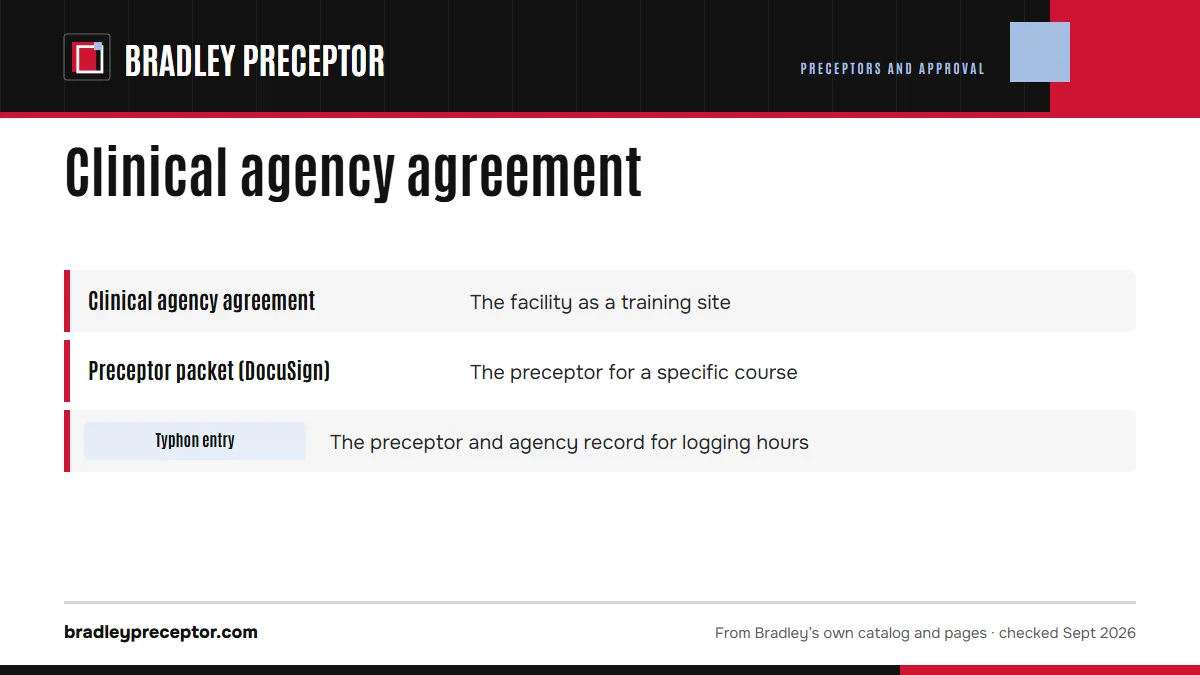
| Clinical agency agreement | The facility as a training site | Bradley and the facility | Before your first practicum day at that site |
| Preceptor packet (DocuSign) | The preceptor for a specific course | You and your preceptor, reviewed by Bradley | By midterm of the semester before the course |
| Typhon entry | The preceptor and agency record for logging hours | You request it; course faculty approve | Before hours are logged |
A signed packet does not mean the site is cleared. A brand-new site can have an approved preceptor and still be waiting on its contract. See the preceptor packet for the packet itself.
Lead time: plan for the slowest party
Bradley publishes no turnaround for agency agreements, and no public Bradley page lists the facilities that already hold one. The pace is often set by the facility. Several large systems in Illinois publish their own timelines, and each is that system's own policy for students from any school, not a statement about Bradley.
- Advocate Health Care asks for two months from the first request to the clinical start, says new agreements can take up to three months, and wants a school affiliation agreement in place before any request.
- Northwestern Medicine's north and northwest region takes students only from affiliated schools, reviews requests at a monthly committee and quotes a four-to-eight-week wait for an answer.
- Carle Health runs an online clinical rotation application and notes that completing it is no promise of a spot.
- OSF HealthCare lists a contact for advanced practice student requests but publishes no timeline.
A small private practice may sign faster, but its contract still has to be done before your term. Each system's process is on sites with their own processes.
Facilities that bring their own paperwork
Some facilities insist on their own contract instead of Bradley's. The 2017 webinars used the VA as the example. Large systems can add layers: Advocate, for instance, wants a three-way preceptorship contract, signed by the hospital, the school and the preceptor's own employer, whenever an outside physician or APRN precepts in its facilities, and it bars preceptors from signing a school's agreement themselves.
None of that is a dead end; it simply moves the calendar. If your preceptor works inside a large system, ask early whether its education or student placement office must be involved, and pass what you learn to Bradley. The sooner the two contract offices connect, the less likely your first clinical day slips. Keep a note of every name and date the site gives you; it saves repeating the story to each new contact.
When the agreement affects where you can train
The handbook's Clinical Location and Movement section ties agreements to geography. A move to an unapproved state, a rotation planned across a border, or a military deployment beyond the continental US all have to reach your advisor or the department chair ahead of the next semester. The handbook's reason is that approvals by state, affiliation contracts and the insurance tied to them can change how you progress.
Switching sites mid-program means a contract for the new facility unless one already exists. The same holds when a preceptor changes employers: the person may already be approved, but the new workplace needs its own agreement. Flag either change to Bradley as soon as you know about it. See relocating during the program if a move is in your plans.
How we keep agreements off your critical path
We plan for the agreement from the first conversation with a site. Your placement advisor learns whether the facility runs its own student process, who signs for it and how long it usually takes, then weighs that against your packet deadline and term start before recommending the site. Where a system's lead time is long, we start sooner or steer toward practices that fit the calendar.
We also gather the facility details Bradley needs to open the contract, so the Office of Online and Distance Education gets accurate information the first time. Bradley handles every agency agreement itself; we make sure nothing on the student side slows it down. Share your course, state and start term using the form on this page; how it works has the full picture.
Questions Bradley students ask
Does Bradley already have agreements with hospitals near me?
Bradley does not publish a list of facilities with current agreements. Your question belongs with the Office of Online and Distance Education, since contracts with sites are part of its remit. If a site already has one, your path is shorter; if not, the office can tell you what the facility will need to sign.
Does a small private practice need an agency agreement too?
Yes. The 2017 webinars made the agreement a requirement for every student's site, and they made no exception for small offices. A solo or small group practice may sign quickly, but the agreement still has to be complete before your first practicum day there.
How long does an affiliation agreement take?
Bradley gives no standard time, and the facility usually sets the pace. Advocate Health Care says new agreements can take up to three months, and Northwestern Medicine asks for four to eight weeks for a placement response. Plan the contract on the same calendar as your packet, which has to be in by the middle of the preceding semester.
What if the facility wants to use its own contract?
That happens, and it is workable. Bradley's 2017 webinars named the VA as a facility with its own agreement, handled through the credentialing coordinator. Tell Bradley as soon as you learn the site has its own form, and share the site's contracting contact, so both sides can start their review early.
Can I start clinical hours while the agreement is still being signed?
No. Each practicum has to be approved before it starts, and the site's agreement is part of clearing it. Hours also cannot begin before the scheduled semester. If the contract is running late, alert course faculty at once; our need a preceptor fast page lists fallback moves.
Related pages
Last checked 2026-09-25
We check these pages against Bradley's own catalog, online program pages and Graduate Student Handbook. Your clinical packet, course faculty and academic advisor have the final word.
- Bradley University Online, FNP welcome site for admitted students
- Bradley University Department of Nursing, Graduate Student Handbook (revised 5/8/2026)
- Bradley University Online, Finding a preceptor for practicums (webinar dated June 20, 2017)
- Northwestern Medicine, student clinical practicum requests (north and northwest)
Bradley lets you choose your preceptors. We find the ones worth choosing.
Tell us your Bradley track, your city and your next practicum course. We line up preceptors who fit the NUR course and gather the license, CV and malpractice details the DocuSign packet asks for, well before the midterm of the semester before you start.
- Preceptors matched to the course: primary care for FNP and AGPCNP, acute care teams for AGACNP, mental health settings for PMHNP
- Preceptor license, CV, malpractice coverage and the site address ready for the packet
- Every practicum in your sequence planned together, close to home in your approved state
Start your placement plan
Track, city and next practicum is all we need to begin.