Who cannot precept you at Bradley, and why
Bradley University rules out four kinds of preceptor for nurse practitioner students: physician assistants, clinical nurse specialists, clinical nurse leaders and your own family members. It also forbids any pay to students for their practicum work, and a preceptor with a license infraction may fail approval. Knowing the exclusions before you ask anyone saves a returned packet.
Get your placement plan
Tell us your Bradley program and where you live. A placement advisor replies with the preceptor and site options that fit your course.
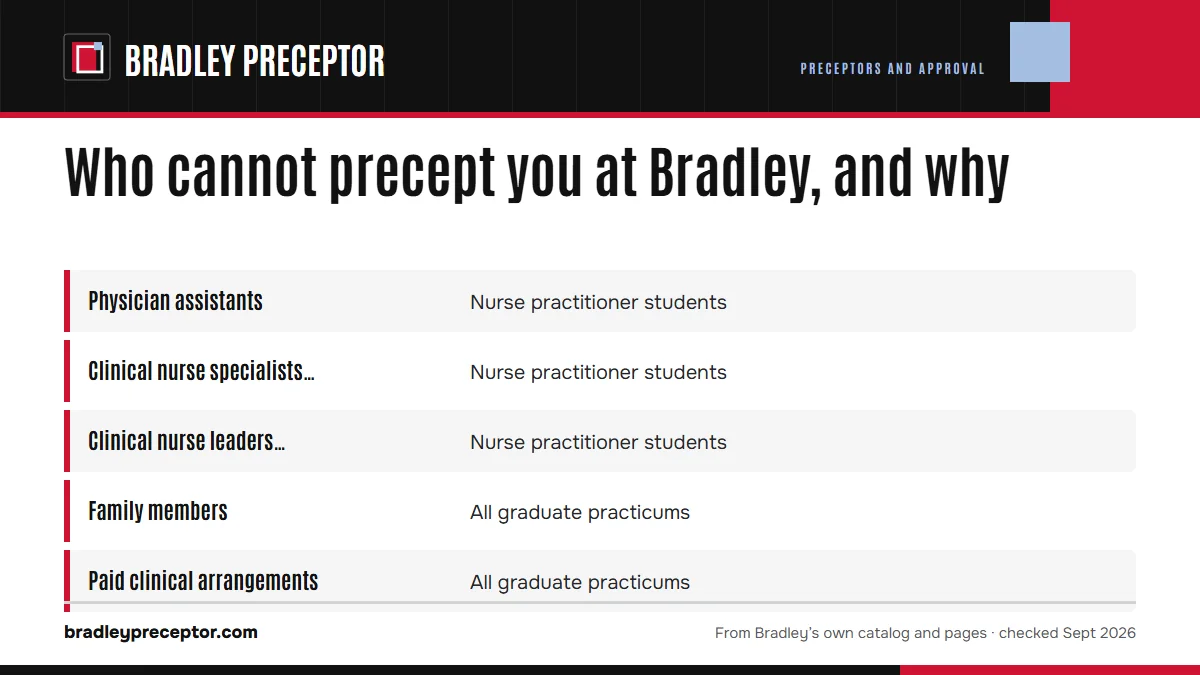
The exclusions at a glance
Six situations keep a preceptor or an arrangement out of a Bradley practicum. Two come from current policy, one from current welcome-site guidance, and three from Bradley's 2017 preceptor webinar, which is still posted but older than today's curriculum.
| Excluded | Applies to | Source |
|---|---|---|
| Physician assistants | Nurse practitioner students | Bradley's 2017 FNP preceptor webinar |
| Clinical nurse specialists (CNS) | Nurse practitioner students | Bradley's 2017 FNP preceptor webinar |
| Clinical nurse leaders (CNL) | Nurse practitioner students | Bradley's 2017 FNP preceptor webinar |
| Family members | All graduate practicums | Graduate Professional Behaviors Policy (update approved 4/23/24) |
| Paid clinical arrangements | All graduate practicums | Graduate Professional Behaviors Policy |
| Preceptors with a license infraction | May not be approved | Bradley's welcome sites for admitted students |
The first three are about credential, the next two about relationships and money, and the last about the preceptor's record. Each is explained below, along with the gray areas the public sources leave open.
Physician assistants, CNSs and CNLs
Bradley's June 20, 2017 FNP webinar named the providers who may precept nurse practitioner students, namely advanced practice nurses, MDs and DOs, and then drew a line at physician assistants, clinical nurse specialists and clinical nurse leaders. Its reasoning was about role: each of those providers works in a different role from a nurse practitioner, so their supervision does not model the job you are training for.
Two limits on that rule matter. Its source is a webinar aimed at FNP students, and nothing public from Bradley settles whether the physician assistant exclusion extends to PMHNP, AGACNP and AGPCNP students. It also predates the current four-course FNP sequence. Treat it as Bradley's standing position unless your track's clinical packet in MyOnline says otherwise, and ask course faculty if a PA is your only lead.
Family members
Under the Graduate Professional Behaviors Policy, choosing a relative as your practicum preceptor is a conflict of interest. That policy was first approved by the Graduate Curriculum Committee on 2/21/2023, with an update approved on 4/16/24 and by the Department of Nursing on 4/23/24. However skilled a relative is, their evaluation of you cannot carry the independence faculty rely on.
Bradley's public materials do not list which relationships count as family for this purpose. If your candidate is an in-law, a partner or someone close to your household, ask course faculty before building the packet around them rather than guessing. Friends, former classmates and coworkers are a different matter: Bradley's 2017 webinar suggested reaching out to coworkers and acquaintances, and the public policies do not bar them.
Being paid for clinical work
That policy also flags pay for anything you do as part of the practicum. Practicum hours are learning hours, not paid work, even when the site would gladly employ you. The rule matters most for students who plan to train where they already work.
In practice, the hours you log in Typhon cannot be hours an employer pays you for. If your clinic suggests scheduling you as an RN while you see patients as an NP student, those are two different roles, and only the unpaid student time can count toward your practicum. Our page on practicum at your workplace covers how students keep the two apart, and the professional behaviors policy page covers the rest of the conduct rules.
Preceptors who may not pass approval
Beyond the named exclusions, some candidates look eligible on paper but stall at review. These are the patterns the public sources point to.
- A license with an infraction: the welcome sites warn that approval can be withheld, and they want every license active and unencumbered.
- A practice outside your approved state: rotations belong in the state Bradley approved for you at admission or where you reside.
- A practice in New York or the District of Columbia for students from those places: Bradley's state table rules out clinicals and DNP projects there.
- A physician-heavy plan for FNP: the 2017 webinar wanted most preceptors to be NPs.
- A site that declines you after reviewing your clearance, which the Clinical Requirements Policy says a site may do.
The full credential rules are on Bradley preceptor requirements.
Right credential, wrong setting
A preceptor can hold an acceptable credential and still be a poor match for the course. An acute care NP on a hospital team suits NUR 656 to NUR 658 for AGACNP, not the primary care focus of NUR 666 to NUR 668 for AGPCNP. A family NP in urgent care may fit NUR 676, yet NUR 678 calls for women's health and pediatric patients.
PMHNP students need mental health settings, and NUR 687 narrows to a sub-specialty, with forensic, consult-liaison, child and adolescent, and geriatric psychiatry among the catalog's examples. Leadership practicums need experienced nurse leaders, and NUR 407 needs a community setting such as a school, a health department or long-term care. For FNP specialty rotations, the 2017 webinar capped specialty care at 100 of 750 hours. A setting mismatch is an easy reason for a packet to come back, and an easy one to prevent.
How we keep ineligible preceptors out of your packet
Every candidate we present to a Bradley student has already been screened against these exclusions: credential, relationship, license standing, state and course setting. Your time goes to preceptors who can actually be approved, and your packet reaches Bradley built on someone who fits.
When your plan needs NPs for most hours, we recruit NPs first and add physician preceptors only where they strengthen the mix. When a question falls outside Bradley's published rules, we flag it for course faculty before the DocuSign packet goes out. If a preceptor drops out mid-course, we stay on call and bring you a replacement who clears the same checks. Bradley decides on every preceptor, and each one we bring arrives prepared for its review. Begin with the form on this page, or see how it works.
Questions Bradley students ask
Can a physician assistant precept a Bradley FNP student?
Not under Bradley's 2017 FNP preceptor webinar, which listed PAs with CNSs and CNLs as providers who may not precept nurse practitioner students because they work in different roles. The webinar is dated, so confirm the current rule in your FNP clinical packet, but build your search around NPs, MDs and DOs.
Can a friend or former coworker be my preceptor?
Bradley's public policies bar family members, not friends or colleagues, and Bradley's 2017 webinar actually suggested contacting coworkers and acquaintances as a first step. The preceptor still needs the right credential, setting and license, and the relationship should leave room for an honest evaluation of your work.
Can a clinical nurse specialist supervise my leadership practicum?
The CNS exclusion in Bradley's 2017 webinar concerned nurse practitioner students. The leadership courses, NUR 631, NUR 633 and NUR 697, are described as guided by experienced nurse leaders, and the public sources do not rule on a CNS serving in a leadership role. Ask course faculty before you submit that packet.
What happens if I submit a preceptor who is not eligible?
The packet comes back not approved, and you start over with a new preceptor while the term start keeps approaching. With packets due halfway through the prior semester, an early submission leaves room to recover. Screening each candidate first is the surest way to keep that time.
Can the clinic pay me for the hours I spend as a student?
No. Bradley's professional behaviors policy for graduate students calls pay for practicum services a conflict of interest. Your paid job and your student hours have to stay separate, even inside the same facility, and only the unpaid student time counts toward the course.
Related pages
Last checked 2026-09-25
We check these pages against Bradley's own catalog, online program pages and Graduate Student Handbook. Your clinical packet, course faculty and academic advisor have the final word.
Bradley lets you choose your preceptors. We find the ones worth choosing.
Tell us your Bradley track, your city and your next practicum course. We line up preceptors who fit the NUR course and gather the license, CV and malpractice details the DocuSign packet asks for, well before the midterm of the semester before you start.
- Preceptors matched to the course: primary care for FNP and AGPCNP, acute care teams for AGACNP, mental health settings for PMHNP
- Preceptor license, CV, malpractice coverage and the site address ready for the packet
- Every practicum in your sequence planned together, close to home in your approved state
Start your placement plan
Track, city and next practicum is all we need to begin.