Bradley MSN FNP: clinical hours, practicums and preceptors
Bradley University's online MSN in Family Nurse Practitioner builds its clinical training on four primary care practicums, NUR 676 through NUR 679, and you pick the preceptor for each one. The 2026-27 course descriptions total 750 hours, RN-entry students add 50 community hours, and one October trip to Peoria comes before the last course. We find the preceptors, fill each DocuSign packet completely and keep the next course lined up.
Get your placement plan
Tell us your Bradley program and where you live. A placement advisor replies with the preceptor and site options that fit your course.
BSN entry or RN entry: two routes to the same four practicums
Bradley offers the MSN FNP from two starting points. BSN holders follow a 50-credit plan. RN-entry students, whose first credential is an associate degree, a hospital diploma or a non-nursing bachelor's, take 59.5 credits, starting with three bridge courses (NUR 300, NUR 303, NUR 404) and a 50-hour community practicum, NUR 407. On Bradley's online page, BSN entry runs about 2.7 years (8 semesters) and RN entry about 3.3 years (10 semesters).
Both routes end in the same FNP practicum sequence, and both require a current, unencumbered RN license and a 3.0 nursing GPA at admission. The application also asks you to include or discuss potential mentors for your clinical experiences, so preceptor planning starts before you are admitted. Our page on naming preceptors when you apply covers what to list.
RN-entry students meet their first preceptor early. NUR 407 needs a preceptor in a community setting (school nursing, a health department or occupational health were examples in Bradley's 2017 webinar), and course faculty approve the choice. The RN-to-MSN page walks through the bridge year.
The four FNP practicums, course by course
Each practicum is a 6-credit course with its own hour target and its own clinical focus, so each one calls for a preceptor whose patient mix matches. Hours climb from 100 in the first course to 300 in the immersion, which means the later courses ask for far more time in clinic.
| Course | Title | Hours | What the preceptor's practice should offer |
|---|---|---|---|
NUR 676 | Primary Care Acute Conditions Across the Lifespan I | 100 | Acute, episodic visits across age groups |
NUR 677 | Primary Care Chronic Conditions Across the Lifespan II | 150 | Ongoing management of chronic disease |
NUR 678 | Primary Care Across the Lifespan III | 200 | Women from adolescence on, plus infants, children and teens |
NUR 679 | Primary Care Immersion IV | 300 | Full primary care across the lifespan, after the bootcamp |
NUR 407 (RN entry only) | Community Health Practicum RN-MSN | 50 | A community or population health setting |
Before NUR 676 you complete BIO 526, NUR 600 and NUR 651; from there the order is strict, with every practicum a prerequisite for the next. NUR 678 can call for two preceptors if one practice cannot cover both women's health and pediatric visits, and each preceptor needs a packet. Course detail lives on pages like the one for NUR 678.
700, 750 or 800 hours: reading Bradley's numbers
Bradley's own sources give different totals for this degree. The 2026-27 catalog's program text says 700 clinical hours for BSN entry, yet the four course descriptions in that same catalog total 750, matching the online program page. The RN-entry version reads 750 in the catalog and 800 online, the second figure being the four FNP courses plus the 50 hours in NUR 407.
The online page adds one more wrinkle: it describes five preceptor-supervised practicums while listing four FNP courses. The number five comes from Bradley's older plan of five 150-hour practicums (NUR 639 through NUR 649), which the catalog still prints but no current program uses.
Plan each rotation to its course's own hour count, since each practicum course carries its own requirement. Then confirm the program total with your academic advisor, who can tell you which catalog year governs your plan of study. The clinical hours page sets every Bradley track side by side.
Build your preceptor calendar from each course's hours (100, 150, 200, 300), not from one program total; the totals in Bradley's sources disagree.
The October FNP Bootcamp and your NUR 679 term
Every FNP student attends a two-day bootcamp on the Peoria campus in October before starting NUR 679. Bradley's MSN FNP page calls it the FNP Bootcamp; the new-student welcome site names it the Nurse Practitioner Skills Workshop and wants you registered in one of the first three practicums at the time. Participants earn continuing education units, and students from other NP specialties may join.
Because it runs once a year, the October you choose shapes your whole practicum calendar. Miss it and NUR 679 waits for the next one. Bradley has not posted the 2026 dates, so watch MyOnline and ask your advisor early.
Your preceptor that term needs to know you will be away for two clinic days plus travel. We build that gap into the schedule when we confirm a preceptor, and the bootcamp page covers the planning in detail.
Who can precept a Bradley FNP student
The catalog asks for "qualified preceptors (NTF Criterion)" and leaves the details to the FNP clinical packet inside MyOnline. The fullest public statement is a 2017 Bradley webinar for FNP students. It approved nurse practitioners, MDs and DOs, turned away PAs, CNSs and CNLs, and required NPs for most rotations (at least three of five under the old plan).
It also let students place as many as 100 hours with specialists, naming dermatology, GI/GU and cardiology. Two current rules sit in writing: an approved preceptor holds a clean, active license, and the Graduate Professional Behaviors Policy rules out family members as preceptors and any pay to you for practicum work.
Nothing public sets a minimum number of years in practice or addresses precepting at your own job. Check the packet for your course and ask course faculty before you commit. Our preceptor requirements page collects every rule we could verify.
From application to your first clinical day
The same checkpoints repeat for every FNP course, and they overlap: while you finish one practicum, the packet for the next one is already due.
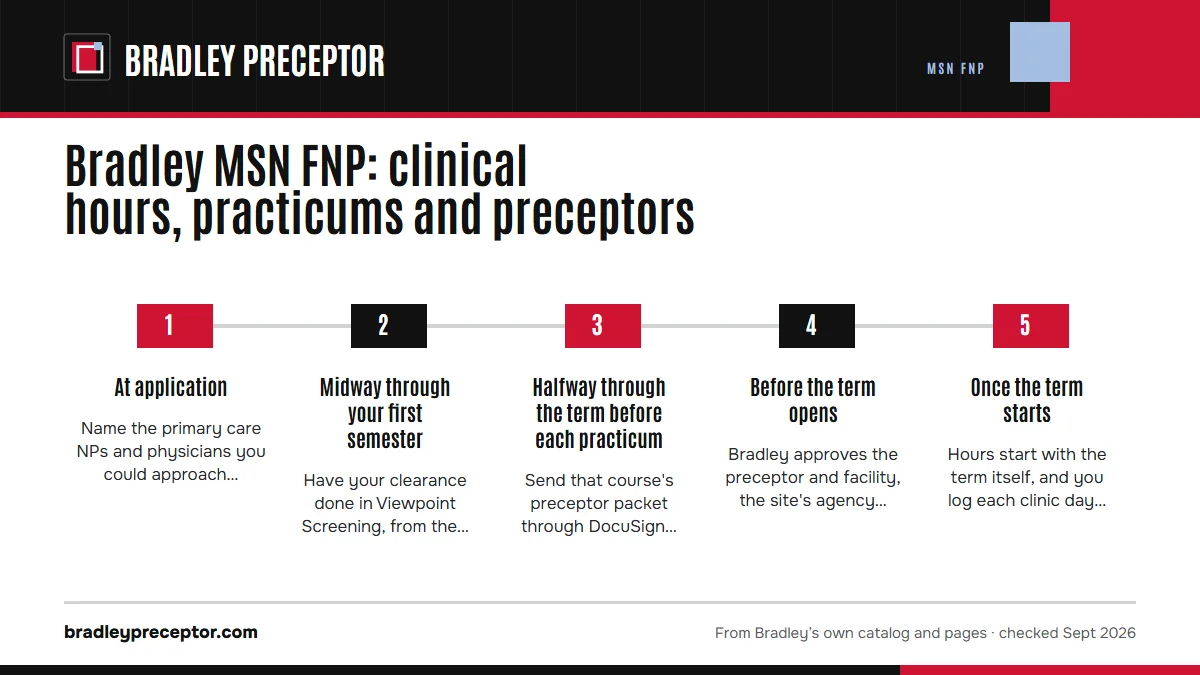
- At applicationName the primary care NPs and physicians you could approach; Bradley's admission requirements ask applicants to include or discuss potential clinical mentors.
- Midway through your first semesterHave your clearance done in Viewpoint Screening, from the criminal check and urine screen to vaccine records, a recent physical and insurance proof.
- Halfway through the term before each practicumSend that course's preceptor packet through DocuSign; Bradley's welcome sites apply this timing to every clinical course.
- Before the term opensBradley approves the preceptor and facility, the site's agency agreement is completed with the credentialing coordinator, and course faculty approve the entry in Typhon.
- Once the term startsHours start with the term itself, and you log each clinic day, with its patient data, in Typhon inside a week.
The deadline calendar gives the detail behind each step.
Why MSN FNP students choose us
We plan all four practicums at once, starting from the course list above. For NUR 676 we look for a practice with a steady flow of acute visits; for NUR 677, a panel with chronic disease follow-up; for NUR 678, women's health and pediatrics, from one family practice or two partners; and for NUR 679, a preceptor with the clinic days to support 300 hours.
Each preceptor we confirm hands over what Bradley's packet asks for, including license, CV, malpractice coverage, the site address and the course, and we check it all before the DocuSign packet goes out, well ahead of the midterm deadline. While one course runs we are already confirming the next, and we schedule your October term around the bootcamp. If a preceptor steps away, your placement advisor starts the replacement search right away.
Every state except Tennessee shows the FNP as meeting licensure requirements in Bradley's state table, and we search inside the approved state where you live. Tell us your entry route and location in the form below to get started.
Questions Bradley students ask
Can one preceptor cover more than one Bradley FNP course?
Under the process in Bradley's 2017 webinar, yes, reused up to twice: for each repeat, only the one-page initial form went back in, along with any documents that had lapsed. The current FNP clinical packet in MyOnline says whether that limit still holds. Using one strong preceptor for two courses can save a packet cycle, so ask course faculty early.
Do telehealth visits count toward Bradley FNP clinical hours?
Possibly, within limits Bradley sets in a separate document. The handbook refers FNP students to telemedicine guidelines that govern how virtual visits count, and those guidelines sit inside MyOnline rather than on a public page. Read them before accepting a preceptor who works mostly by video.
Which certification exams can Bradley MSN FNP graduates take?
Bradley's catalog says graduates may sit for the FNP certification exam from either the AANP or the ANCC. The handbook's comprehensive assessment for this degree is the exit exam given in NUR 690, which MSN FNP students pass before graduating.
Can I live outside Illinois and still do the MSN FNP?
Yes. Bradley's online programs enroll RNs in many states, and your rotations stay in the approved state tied to your admission or your home. Bradley may also ask you to hold RN licensure wherever a rotation takes place. The state disclosures page explains the table and its footnotes for California, New York and Ohio.
When should I start looking for my first FNP preceptor?
Earlier than feels necessary. Your NUR 676 packet has to reach Bradley at the midpoint of the semester before that course begins, and Bradley's 2017 webinar told FNP students to begin searching a year ahead. Starting at admission gives you time to find a preceptor whose schedule fits all 100 hours.
Related pages
Last checked 2026-09-25
We check these pages against Bradley's own catalog, online program pages and Graduate Student Handbook. Your clinical packet, course faculty and academic advisor have the final word.
- Bradley University catalog 2026-27: MSN Family Nurse Practitioner (BSN entry)
- Bradley University catalog 2026-27: NUR course descriptions
- Bradley University Online: MSN FNP program page
- Bradley University Online: FNP welcome site
- Bradley University Department of Nursing: Graduate Student Handbook (rev. 5/8/2026)
Bradley lets you choose your preceptors. We find the ones worth choosing.
Tell us your Bradley track, your city and your next practicum course. We line up preceptors who fit the NUR course and gather the license, CV and malpractice details the DocuSign packet asks for, well before the midterm of the semester before you start.
- Preceptors matched to the course: primary care for FNP and AGPCNP, acute care teams for AGACNP, mental health settings for PMHNP
- Preceptor license, CV, malpractice coverage and the site address ready for the packet
- Every practicum in your sequence planned together, close to home in your approved state
Start your placement plan
Track, city and next practicum is all we need to begin.