Malpractice insurance, the clinical badge and dress for Bradley clinicals
Bradley University arranges professional liability (malpractice) insurance for each graduate practicum course and bills it through course fees. What you supply is the rest of the first-day kit: the Bradley clinical badge, ordered under the Photo & ID tab in MyOnline, and professional attire with a white lab coat for every clinical day.
Get your placement plan
Tell us your Bradley program and where you live. A placement advisor replies with the preceptor and site options that fit your course.
Three things to settle before your first clinical day
Before you walk into a practice as a Bradley student, three things should already be in place: malpractice coverage for the course, your Bradley clinical badge and the right clothes. The first comes through Bradley, the second you order, and the third you provide.
They sit on top of the clearance you finished in Viewpoint Screening and the approvals behind your preceptor packet. Bradley's welcome sites list the white lab coat, professional attire and the clinical badge as required dress from the moment you enter clinical rotations, so they belong on your readiness list, not your someday list.
None of the three is hard, but each has a lead time: coverage is tied to your enrollment in the practicum course, the badge travels by mail, and a lab coat that fits is worth buying before the week you need it.
Malpractice insurance: how Bradley covers each practicum
The Graduate Student Handbook says professional liability insurance for each practicum course is provided through course fees. Bradley's online tuition page lists malpractice insurance as a yearly nursing fee, and Bradley's 2017 preceptor webinar told students they buy the coverage through Bradley. The tuition page carries the current amount, which Bradley reviews each academic year.
Because the coverage is tied to the practicum course, it is one more reason to keep every hour inside an approved practicum and inside the semester, as the handbook requires. Hours with a preceptor Bradley has not approved, or before the term opens, fall outside the rules the whole system is built on.
The handbook also flags that when you move or train over a state line, the site's affiliation agreement and the liability coverage attached to it may affect your progression. If your plans cross a state line, raise it with your advisor before the semester starts. Separately, the 2026 handbook says students pay any costs from incidents or injuries at an agency.
Your coverage and your preceptor's are different
Bradley's 2017 preceptor webinar listed a copy of the preceptor's own malpractice insurance among the packet documents, next to the preceptor's license and current CV. That is the preceptor's professional coverage, separate from the student coverage Bradley arranges for you.
The current packet forms sit in your track's clinical packet in MyOnline, so check there for today's list. When a preceptor agrees to take you, ask for the coverage certificate in that first conversation; it may have to come from an employer's risk office rather than from the preceptor, and that can add days.
Keep a copy of every document you send. If the same preceptor takes you again for a later course, Bradley's 2017 guidance was that updated documents are needed when the old ones have expired by the time the rotation starts.
Health insurance is a separate requirement
Malpractice coverage answers for claims arising from your clinical work. Health insurance covers your own care. Bradley requires both, and they run on different tracks.
Active health and hospitalization insurance is one of the items in the Graduate Clinical Requirements Policy. The proof follows a set rhythm: first-semester midterm, the term just before your clinicals, then each February 1, with any change of plan reported inside two weeks. The upload happens in Viewpoint; the Clinical Requirements Policy page explains the rest of that list.
Keep an image of your insurance card beside your Viewpoint confirmation. Clinical sites can add requirements of their own during onboarding, and proof of coverage is an easy one to answer when it is already on your phone.
The Bradley clinical badge
Online students receive their Bradley student ID and clinical badge by mail. The welcome sites place both under the Photo & ID tab in MyOnline.
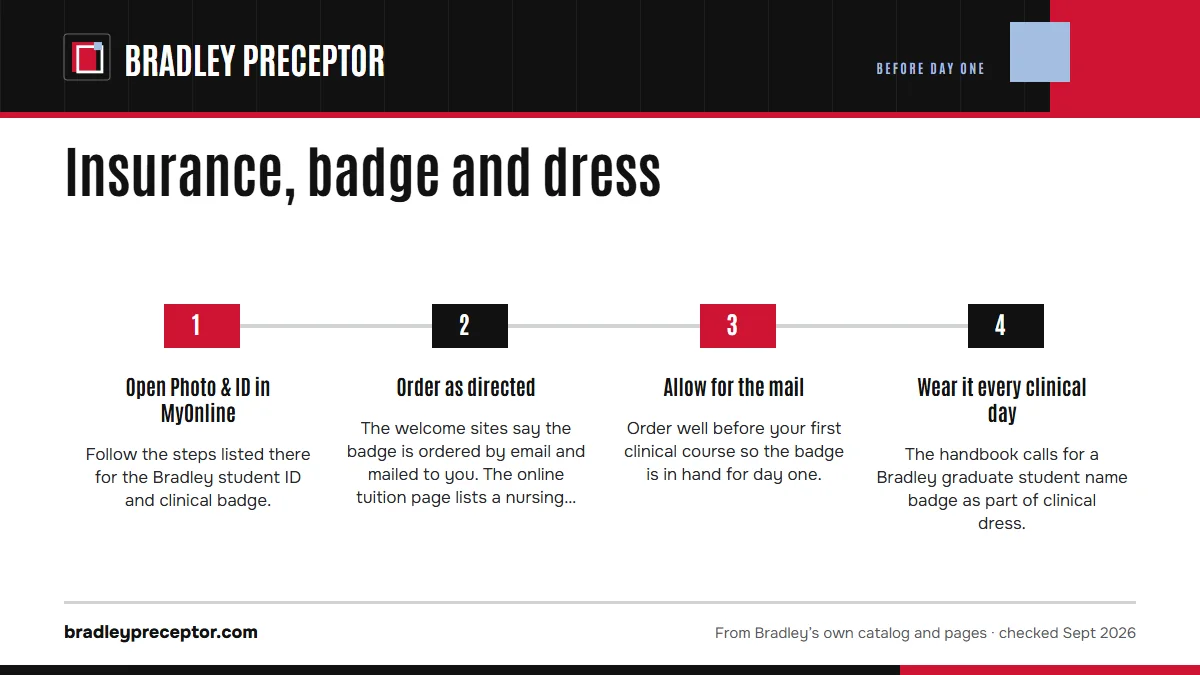
- Open Photo & ID in MyOnlineFollow the steps listed there for the Bradley student ID and clinical badge.
- Order as directedThe welcome sites say the badge is ordered by email and mailed to you. The online tuition page lists a nursing badge fee plus shipping.
- Allow for the mailOrder well before your first clinical course so the badge is in hand for day one.
- Wear it every clinical dayThe handbook calls for a Bradley graduate student name badge as part of clinical dress.
What to wear
The graduate handbook's dress rule is short: professional clothing, a white lab jacket and a Bradley graduate student name badge. The welcome sites say the same thing in their own words for students about to enter clinical rotations.
Bradley's Dress Code for Practicum (updated November 2024) describes the campus undergraduate uniform, so graduate students follow the handbook rule instead. Your site may keep its own expectations, so ask your preceptor before the first day whether the practice has a dress standard of its own or issues its own ID.
Set out the lab coat and badge the night before your first day, and keep Bradley's approval email on your phone in case the front desk asks who you are and why you are there.
A first-day checklist
- Bradley clinical badge, worn where it can be seen
- White lab coat over professional clothing
- Confirmation that Bradley approved your preceptor and site for this course
- Typhon access working, so the first day can be logged within 7 days
- Viewpoint clearance complete, with health insurance proof current
- Any onboarding the site asked for, such as its own forms or a repeat background check
- The course's clinical packet items from MyOnline, including any evaluation forms your preceptor will complete
If any item is still missing a week before the course, tell your academic advisor then rather than on the first morning. The Typhon guide covers the logging side.
Why Bradley students choose us for a ready first day
The placement desk makes sure the preceptor side of that checklist is done early. We collect your preceptor's license, CV and malpractice certificate along with the site address and the course, so the DocuSign packet reaches Bradley complete, and we confirm any site onboarding before your first day.
You bring the badge and the lab coat; we handle the chase for documents from busy practices. We also note what each practice expects on the first morning, from arrival time to who meets you, so day one starts with patients rather than paperwork. Put your track and upcoming course in the form on this page, or see how it works.
Questions Bradley students ask
Do I need to buy my own malpractice insurance for Bradley clinicals?
Bradley's Graduate Student Handbook says professional liability insurance for each practicum course comes through course fees, and the online tuition page lists it as a yearly nursing fee. If a site asks about extra coverage, check with your academic advisor before buying anything on your own.
How long does the Bradley clinical badge take to arrive?
Bradley does not publish a delivery time. The badge is ordered by email through the steps under MyOnline's Photo & ID tab and then mailed, so order it as soon as your first clinical course is on your schedule and leave room for postal delays.
Do graduate students wear the Bradley nursing uniform?
No. The Dress Code for Practicum covers the campus undergraduate uniform. Graduate students wear professional clothing with a white lab jacket and the Bradley graduate student name badge, as the Graduate Student Handbook describes, plus anything their clinical site adds.
Does my preceptor need malpractice insurance?
Bradley's 2017 preceptor webinar listed a copy of the preceptor's malpractice insurance, license and current CV among the packet documents. Your track's current clinical packet in MyOnline has today's list. Ask your preceptor for the coverage certificate early, since it may come from an employer.
Who pays if I am hurt at a clinical site?
The 2026 Graduate Student Handbook says students pay any costs arising from incidents or injuries at an agency. Keep the health insurance Bradley requires active throughout the program, and report any incident to your preceptor and course faculty right away.
Related pages
Last checked 2026-09-25
We check these pages against Bradley's own catalog, online program pages and Graduate Student Handbook. Your clinical packet, course faculty and academic advisor have the final word.
- Bradley University, Graduate Student Handbook (liability insurance and dress, p. 12)
- Bradley University Online, FNP welcome site (student ID and clinical badge)
- Bradley University Online, tuition and fees
- Bradley University Online, Finding a Preceptor for Practicums (June 20, 2017 webinar)
- Bradley University, Dress Code for Practicum
Bradley lets you choose your preceptors. We find the ones worth choosing.
Tell us your Bradley track, your city and your next practicum course. We line up preceptors who fit the NUR course and gather the license, CV and malpractice details the DocuSign packet asks for, well before the midterm of the semester before you start.
- Preceptors matched to the course: primary care for FNP and AGPCNP, acute care teams for AGACNP, mental health settings for PMHNP
- Preceptor license, CV, malpractice coverage and the site address ready for the packet
- Every practicum in your sequence planned together, close to home in your approved state
Start your placement plan
Track, city and next practicum is all we need to begin.