The Bradley clinical placement process, from application to your first clinical day
At Bradley University, online graduate nursing students recruit their own preceptors and sites, and Bradley signs off on both before a single hour counts. The route has six checkpoints: the names on your application, clearance in Viewpoint Screening, the DocuSign preceptor packet, the clinical agency agreement, faculty approval in Typhon, and the first day of the term.
Get your placement plan
Tell us your Bradley program and where you live. A placement advisor replies with the preceptor and site options that fit your course.
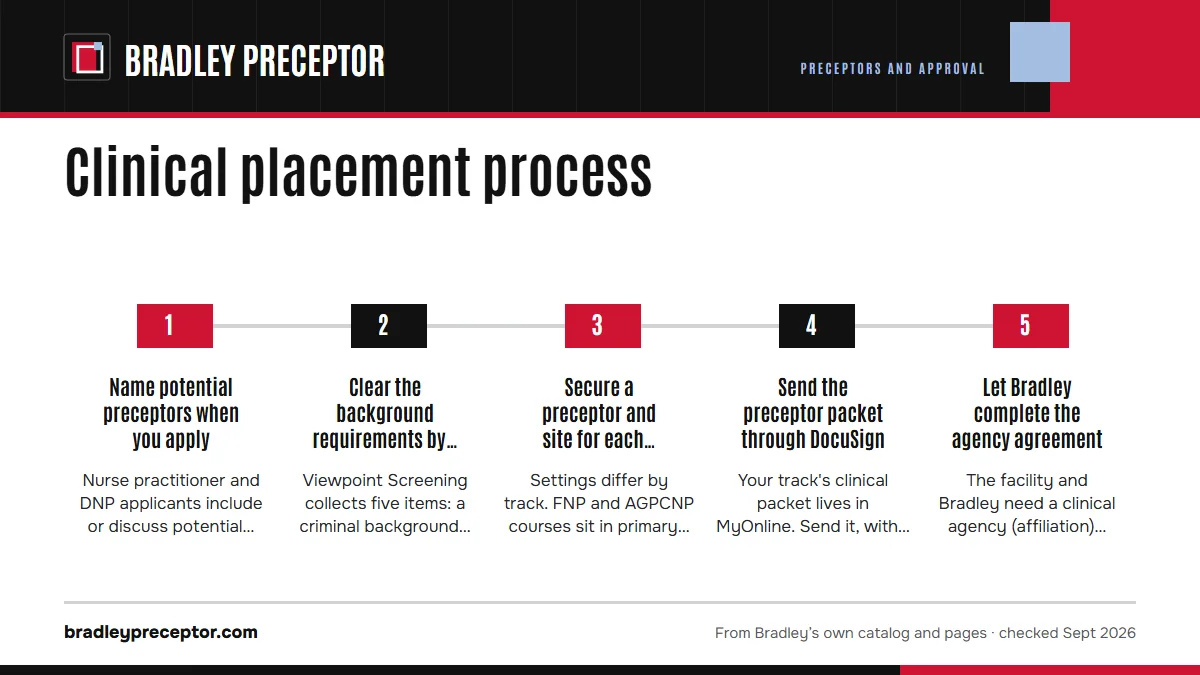
How the model works: you recruit, Bradley approves
Every online graduate track at Bradley, from the four nurse practitioner specialties to Nursing and Healthcare Leadership and the DNP, runs on the same division of labor. You identify a preceptor or practice mentor and a facility for each practicum course. The Department of Nursing reviews them, the facility paperwork gets completed, and course faculty open the practicum in Typhon.
Page 12 of the current Graduate Student Handbook, the edition revised in May 2026, states the expectation in capitals: students "arrange and attend EVERY scheduled practicum experience." The welcome sites for admitted students say it more gently, asking new students to take the lead in tracking down both the practice and the person who will teach them. What Bradley offers in return is choice: your own town, your own clinic, and a schedule you set with your preceptor.
Campus BSN and accelerated BSN students follow a different path, because faculty arrange those rotations in Peoria. For what the choice looks like day to day, see choosing your own preceptor at Bradley.
The six checkpoints, in the order you meet them
- Name potential preceptors when you applyNurse practitioner and DNP applicants include or discuss potential clinical mentors in the application, and DNP Leadership applicants discuss practice mentors for their project. The names are a starting list, not an approval. More on what to list at application.
- Clear the background requirements by first-semester midtermViewpoint Screening collects five items: a criminal background check, a multi-panel drug test, your vaccination record, a recent physical exam and proof of health coverage. The Department of Nursing and the clinical coordinator review what comes back.
- Secure a preceptor and site for each practicum courseSettings differ by track. FNP and AGPCNP courses sit in primary care, AGACNP in acute care and PMHNP in mental health; leadership students work beside nurse leaders, and
NUR 407happens in the community. - Send the preceptor packet through DocuSignYour track's clinical packet lives in MyOnline. Send it, with the preceptor's documents, before the middle of the semester that comes ahead of the course. See the preceptor packet.
- Let Bradley complete the agency agreementThe facility and Bradley need a clinical agency (affiliation) agreement. The welcome sites place these contracts with the Office of Online and Distance Education; in the 2017 webinars, a credentialing coordinator did the work.
- Get the Typhon entry approved, then start with the termEnter the preceptor and the agency in Typhon for course faculty to approve. The clock for hours opens with the semester itself, and every clinical day needs its log within a week.
A timeline for one practicum course
Working backward from the course start keeps deadlines honest. The table uses a practicum that begins in spring 2027, when Bradley's university calendar opens the semester on January 20. The online term dates sit in the academic calendar inside MyOnline, so confirm each one there.
| When | What happens | Who moves it |
|---|---|---|
| At application | Potential preceptors or mentors named | You |
| By midterm of your first semester | Viewpoint Screening items complete and reviewed | You, then the Department of Nursing |
| Early fall 2026 | Preceptor recruited and documents gathered | You, or your placement advisor |
| Midterm of fall 2026 | DocuSign preceptor packet due | You and your preceptor |
| After the packet is approved | Clinical agency agreement completed | Bradley and the facility |
| One or two weeks before your first clinical course | Typhon access arrives by B-Mail; open it within 72 hours | You |
| The first week of the term | First clinical day; each day logged within 7 days | You and your preceptor |
Fall 2026 on the university calendar runs from August 26 to December 19, which puts its midpoint in October; the online calendar gives the exact cutoff. For a fall practicum, shift everything back one semester. Our page on Bradley clinical deadlines collects each date in one place.
What Bradley does and what stays with you
Bradley's side of the work
- Approves the preceptor and the health care facility for every practicum.
- Runs agency and affiliation contracts with sites and coordinates packets and onboarding, work that falls to the Office of Online and Distance Education.
- Reviews your background check, drug screen, vaccines, physical and insurance together with the clinical coordinator.
- Signs off on the preceptor and agency entry in Typhon through course faculty.
Your side is the search, the packet and the calendar. You find a willing, eligible preceptor, get the packet signed and submitted, keep Viewpoint Screening current, agree on clinical days with your preceptor, and log hours and patient data in Typhon. Your academic advisor, a nursing faculty member, fields practicum questions, and the Student Support Coach is the first stop for everything else. Our credentialing and approvals page maps each role.
Where the process tends to stall
Most delays trace back to one of four things. The first is timing: the packet deadline lands in the semester before the course, so a search that starts over the winter break is already behind. The second is clearance, because an open Viewpoint Screening item can put a hold on registration.
The third is the preceptor's own record. According to the welcome sites, an infraction on a preceptor's license can sink approval, and only active, unencumbered licenses qualify. The fourth is geography. Your clinicals stay inside your approved home or admission state, and you need an RN license that is valid where the site sits. See RN licenses for clinicals.
Sites hold a veto over students too: a conviction, a failed drug test or gaps in vaccines can lead a facility to say no. Because clinicals are required for graduation, the Clinical Requirements Policy warns that such a refusal can push your finish date back.
Your packet deadline lands midway through the previous semester, months before the course opens.
The 2017 webinar version, and how to read it
Much of the step-by-step detail students find online comes from two Bradley preceptor webinars dated June 20, 2017, still posted on Bradley's online site. They describe a packet sent about seven weeks before the clinical start, an approval email in roughly five business days, and a preceptor who could be reused, though only twice.
Treat those numbers as history. The current welcome sites set the packet deadline at midterm of the prior semester and route submission through DocuSign instead of the 2017 routine of scanning and emailing forms. The webinars also predate today's four-course FNP sequence, NUR 676 through NUR 679. Where a webinar and your track's clinical packet disagree, follow the packet in MyOnline and ask your academic advisor about anything it leaves open.
Why Bradley students choose us for this path
We are built around this exact sequence. Your placement advisor searches for preceptors and sites that fit your Bradley course and your approved state, checks each candidate's credential and setting against Bradley's published rules, and gathers every document the packet calls for, from the preceptor's license and CV to proof of malpractice coverage and the site address, so the DocuSign envelope goes out complete well ahead of the deadline.
While one practicum runs, we line up the next. For FNP students we plan clinical weeks around the October bootcamp in Peoria, and if a preceptor drops, we stay on call and start the replacement search right away. Bradley still approves every preceptor and handles every agreement; our work puts a finished, rule-ready file in front of Bradley on the first pass. Read how it works, or use the form below to share your course and when it starts.
Questions Bradley students ask
How long does Bradley take to approve a preceptor packet?
Bradley's current welcome sites give a due date, the middle of the prior semester, but say nothing about how fast reviews come back. The 2017 preceptor webinar mentioned about five business days and an email marked approved or not approved. Leave more margin, since an unapproved packet still needs replacing before the term. Your track's clinical packet in MyOnline describes the current process.
Can I count clinical hours from before the semester starts?
No. Per the handbook, a practicum's hours start with the scheduled semester, however early your preceptor was approved. Time worked while on a leave of absence is excluded as well. If you carry an Incomplete, hours over a break need approval from the lead faculty member before you work them.
Does Bradley place online graduate nursing students with preceptors?
Bradley's public pages describe a student-led model: the online program pages market preceptor choice as a benefit, and the handbook puts each practicum's arrangements on the student. None of them describes a placement service or a preceptor list. Bradley's role is approval, agreements, clearance and hour tracking. Campus BSN students are the exception, since faculty arrange their rotations at Peoria-area agencies.
What happens to my clinical plan if I move to another state?
Let your academic advisor or the department chair know ahead of the next semester. Clinicals are tied to your approved state of admission or residence, so relocating can change state approval, a site's affiliation agreement and its liability coverage. A license in the new state might be needed as well. Our page on relocating during the program covers the details.
Where do I find my track's clinical packet?
In MyOnline, Bradley's portal for online students, which has a Clinicals tab next to the Health Requirements and Schedule tabs. The Graduate Student Handbook names a Clinical Packet and Guidelines document per track, plus a DNP Project Practice Mentor Packet, and points to MyOnline for all of them. The packets are not posted publicly, so the MyOnline version is the one to follow.
Related pages
Last checked 2026-09-25
We check these pages against Bradley's own catalog, online program pages and Graduate Student Handbook. Your clinical packet, course faculty and academic advisor have the final word.
Bradley lets you choose your preceptors. We find the ones worth choosing.
Tell us your Bradley track, your city and your next practicum course. We line up preceptors who fit the NUR course and gather the license, CV and malpractice details the DocuSign packet asks for, well before the midterm of the semester before you start.
- Preceptors matched to the course: primary care for FNP and AGPCNP, acute care teams for AGACNP, mental health settings for PMHNP
- Preceptor license, CV, malpractice coverage and the site address ready for the packet
- Every practicum in your sequence planned together, close to home in your approved state
Start your placement plan
Track, city and next practicum is all we need to begin.