Relocating during your Bradley nursing program
A move in the middle of Bradley University's online nursing program sets off four tasks: a conversation with your academic advisor or the department chair before the next semester opens, a look at Bradley's state table for your track, an RN license for the new state, and a fresh clinical plan. Preceptors near your old home may stop being practical, and each new site needs its own packet and approval.
Get your placement plan
Tell us your Bradley program and where you live. A placement advisor replies with the preceptor and site options that fit your course.
What Bradley asks of you when you move
A short handbook section titled Clinical Location and Movement governs this. It ties your rotations to the approved state that admitted you, the state you now physically live in, or both, and it lists three changes that must reach your academic advisor or the department chair ahead of the coming semester:
- relocating somewhere Bradley has not approved for your program
- any plan to train across a state line in a neighboring state, whether or not that state is approved
- military orders that send you beyond the continental United States
The reason is spelled out: state approval, each site's contractual affiliation agreement and the liability coverage that rides on it can all change how you progress. The handbook also cautions that a rotation state can require its own RN license from you even when you live somewhere else.
The Office of Online and Distance Education adds two housekeeping steps. Put the new address into MyOnline, and look up your new state on Bradley's State Disclosures page to see whether your program is offered there.
Step one: check the new state against Bradley's table
Bradley's online nursing table answers the first question in seconds. The FNP column covers every state except Tennessee; the PMHNP and both AG columns leave out four. New York and the District of Columbia read YES with a catch, since residents there must do their clinical work and any DNP project outside their own jurisdiction.
A NO for your track calls for an advisor conversation before you commit to a lease, because it speaks to your license after graduation as well as to your clinicals. Leadership students will not find their programs in the table at all and should ask the question directly. The state disclosures page reads the whole table, footnotes included.
A move overseas is another matter. Bradley's online office says its authority to teach online ends at the U.S. border, and students heading abroad are generally advised to pause their studies.
Step two: the license that goes with your new address
Bradley's welcome sites tie your nursing license to the place where clinical courses happen, so a license from the new state has to be active, unencumbered and in hand before the first hour there. Boards work at different speeds; apply as soon as the move is certain rather than after you arrive.
The compact changes the math. Illinois has stayed out of the Nurse Licensure Compact, while neighboring Missouri, Iowa, Wisconsin, Kentucky and Indiana belong to it. NCSBN says nurses who live in a compact state can apply for a multistate license, so an Illinois nurse moving to one of those states looks to the new home state's board for that license, and a nurse moving into Illinois needs an Illinois RN license from IDFPR, since a multistate license does not reach Illinois.
Illinois statute does exempt some out-of-state RNs who train in an Illinois graduate program, yet Bradley's license requirement goes further than the statute, and Bradley's requirement is what binds you. The RN license page goes deeper.
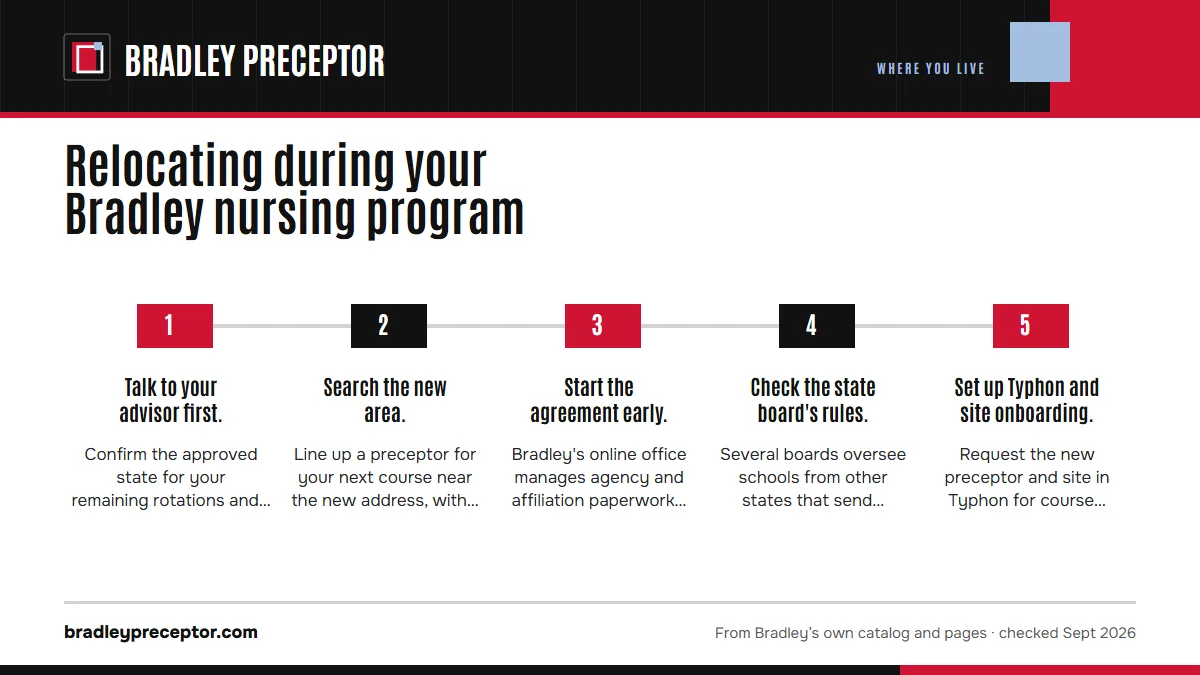
Step three: rebuild the clinical plan
- Talk to your advisor first.Confirm the approved state for your remaining rotations and which courses are still ahead, before the semester in question begins.
- Search the new area.Line up a preceptor for your next course near the new address, with the documents the DocuSign packet asks for, finished around the halfway mark of the semester that precedes that course.
- Start the agreement early.Bradley's online office manages agency and affiliation paperwork with each new site. Health systems that use their own contracts can take weeks; Advocate's student pages allow up to three months for a new agreement.
- Check the state board's rules.Several boards oversee schools from other states that send students into their facilities. Wisconsin requires its board's approval of out-of-state nursing schools, and Alabama expects a letter of intent at least 15 days before clinicals begin. Each state guide lists its board's rule.
- Set up Typhon and site onboarding.Request the new preceptor and site in Typhon for course faculty approval, and complete whatever the new site asks of its students.
Moving in the middle of a course
Bradley publishes no procedure for changing sites partway through a practicum. Its general rules still hold: hours at a new site count only after that site is approved, and each clinical day still needs a Typhon entry within the week. Tell course faculty as soon as the move date is firm.
You have a few ways to bridge the gap. Front-loading hours at your current site before the truck arrives is the simplest, if your preceptor can take extra days. An Incomplete may be available if you meet the department's conditions, which the semester calendar page spells out. A leave of absence can last up to a year, though no clinical hours accrue while you are on it.
A Bradley landing page quotes an MSN-AGACNP graduate whose placements were reworked partway through a semester after a job change. Treat that as an anecdote rather than a rule. If hours fall behind, behind on clinical hours has recovery options.
Timing a move around the semester
The cleanest moves fall between semesters, with the advisor conversation held before the new one opens. Because each packet is due around the middle of the semester that precedes its course, the preceptor at your new address needs to be settled a full term ahead. A December move with a spring practicum means a new-state preceptor ready by midterm of fall. If the date is flexible, pick the one that lets your current course finish where it started.
FNP students keep one fixed trip wherever they live: two days in Peoria each October for the FNP Bootcamp, which must come before NUR 679. AGACNP and AGPCNP students owe a similar on-site skills session ahead of NUR 658 or NUR 668, with dates still unannounced.
How we handle a move for Bradley students
A move is where our head start pays off most. Your placement advisor starts searching the new area as soon as you know the date, confirms the state reads YES for your track, and checks your license timeline with you so no hours stall. We assemble the full DocuSign packet for the new preceptor ahead of its deadline while your current site stays in place.
We also map any board rule the new state applies to schools from elsewhere, so you can raise it with Bradley early. Every approval remains Bradley's call; the packet it receives will be whole. Send your moving date and new city with the form below, or write to us from the contact page.
Questions Bradley students ask
Do I have to tell Bradley if I move to another state?
Yes, whenever the move affects where your clinical work can happen. The handbook wants your advisor or the chair told ahead of the next semester about a move to an unapproved state, a plan to train in a neighboring state, or deployment orders abroad. Bradley's online office also wants your new address entered in MyOnline.
Can I keep my old preceptor after I move?
Possibly, if you can still get to the site. Bradley's handbook links rotations to the approved state that admitted you and to the state you live in, so your admission state may remain an option on paper. Travel, your license in that state and your advisor's approval decide whether it works in practice. Raise it before the semester begins.
What if I move to a state marked NO for my track?
Raise the move with your academic advisor first. A NO on Bradley's table is Bradley's finding that the program falls short of that state's education requirements for licensure in your specialty, which affects your career there as well as your clinicals. The state disclosures page lists which states read NO for which tracks.
Can I stay in the program if I move abroad?
Bradley's online office says it holds no authority to run online programs in other countries, and it generally advises students moving abroad to step away from the program. Deployment beyond the continental US is also one of the changes the handbook wants reported before a semester. Your advisor can talk through a leave of absence, which may last up to a year.
Will a new site ask for another background check?
It may. Bradley's policy ties Viewpoint Screening clearance to midterm of your first semester and says nothing about repeating it after a move, but individual sites add their own requirements. Bradley's 2017 FNP webinar noted that some sites asked for a repeat background check when Bradley's was more than a year old. Check the new site's onboarding list early.
Related pages
Last checked 2026-09-25
We check these pages against Bradley's own catalog, online program pages and Graduate Student Handbook. Your clinical packet, course faculty and academic advisor have the final word.
Bradley lets you choose your preceptors. We find the ones worth choosing.
Tell us your Bradley track, your city and your next practicum course. We line up preceptors who fit the NUR course and gather the license, CV and malpractice details the DocuSign packet asks for, well before the midterm of the semester before you start.
- Preceptors matched to the course: primary care for FNP and AGPCNP, acute care teams for AGACNP, mental health settings for PMHNP
- Preceptor license, CV, malpractice coverage and the site address ready for the packet
- Every practicum in your sequence planned together, close to home in your approved state
Start your placement plan
Track, city and next practicum is all we need to begin.