Bradley post-master's PMHNP certificate: psychiatric preceptors on a short timeline
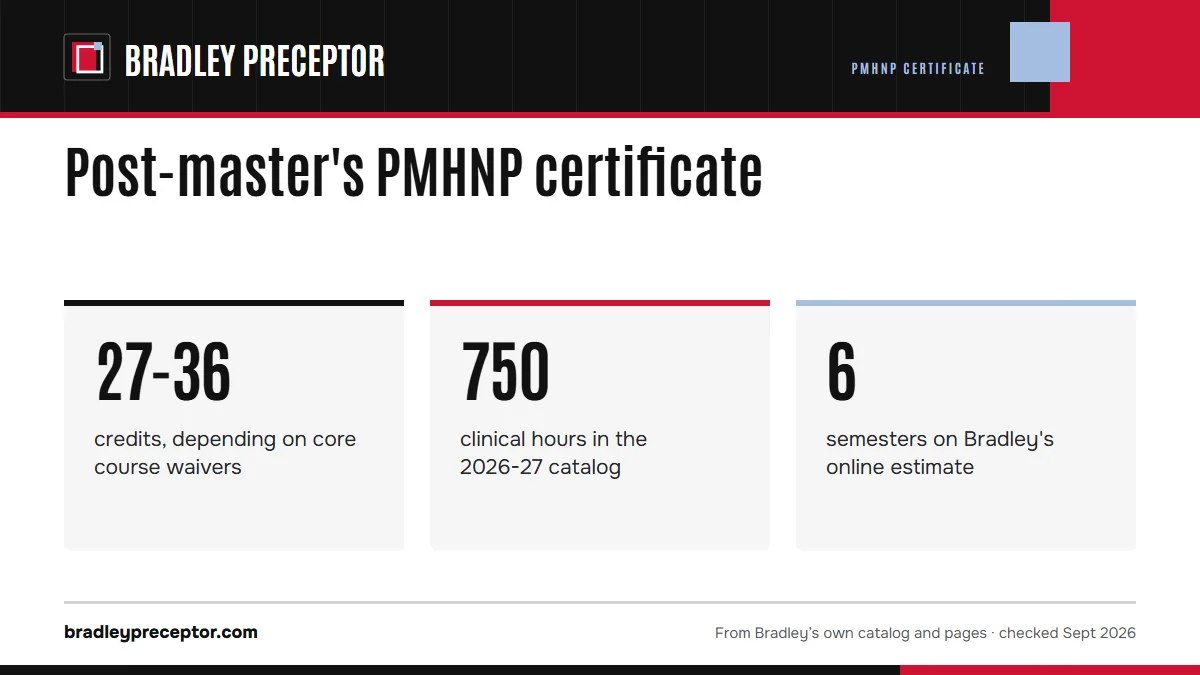
Bradley University's post-master's PMHNP certificate gives an MSN-prepared RN the full PMHNP clinical sequence, 750 hours, in 27 to 36 credits. With no doctoral core and no bridge courses, the clinical courses come quickly after admission. We start your psychiatric preceptor search early and keep each packet a semester ahead of its course.
Get your placement plan
Tell us your Bradley program and where you live. A placement advisor replies with the preceptor and site options that fit your course.
What the certificate includes
Applicants are licensed RNs holding a nursing master's from a CNEA, ACEN or CCNE accredited school. The full plan runs 36 credits: three core courses, BIO 526, NUR 600 and NUR 651, then NUR 680 PMHNP Roles, NUR 682 Psychopharmacology and Neurophysiology for the PMHNP, the four clinical courses from NUR 684 to NUR 687, and NUR 688 Professional Aspects of the PMHNP.
Any of the three core courses can be waived if you completed it within five years with a B or better, which brings the plan down to 27 credits. Bradley's online page lists 2 years across 6 semesters, while its duration widget says 16 to 24 months; your plan of study in MyOnline is the version to trust.
Graduates may sit for the PMHNP certification exam from the ANCC or AANP. The handbook lists no comprehensive assessment for certificate students.
How waivers pull your first practicum forward
NUR 684 lists the three core courses as prerequisites and runs together with NUR 680 and NUR 682. With the core waived, NUR 684 can sit near the very start of your plan, and NUR 685 follows it directly.
Under Bradley's timing rule, a course's preceptor packet goes through DocuSign at the halfway point of the preceding term. If NUR 685 falls in your second semester, its packet is due in your first, in the same half-term as your clearance items in Viewpoint Screening under the Graduate Clinical Requirements Policy.
One more variable: the catalog treats the 150 hours in NUR 684 as simulation guided by the practicum instructor, but Bradley's online page describes them as precepted hours at a facility. If your cohort follows the online description, your first preceptor is needed a semester sooner still. Ask your advisor at orientation, and see the clinical deadlines page.
With waivers, your first psychiatric preceptor packet may be due in your first semester; start the search at admission, not at your first practicum.
The clinical sequence, hour by hour
The certificate total has been 750 since the 2026-27 catalog; the 2024-25 catalog set the PMHNP at 600, with a much smaller NUR 684. The four courses must be taken in order, and the three precepted ones account for 600 hours with a preceptor if NUR 684 stays a simulation course.
| Course | Credits | Hours | Focus |
|---|---|---|---|
NUR 684 | 5 | 150 | Psychiatric interviewing and differential diagnosis (simulation in the catalog) |
NUR 685 | 6 | 200 | Continuum of care across the lifespan, practicum I |
NUR 686 | 6 | 250 | Continuum of care across the lifespan, practicum II |
NUR 687 | 4 | 150 | Sub-specialty practicum |
NUR 687 is the course that asks for a specific sub-specialty setting; the catalog's examples are forensic settings, consult liaison, child and adolescent psychiatry and care of older adults. The NUR 685 and NUR 686 pages cover the two core practicums in detail.
Choosing your NUR 687 sub-specialty early
NUR 687 is the last and most specific course: 150 hours in one psychiatric sub-specialty. On a certificate timeline it can arrive within a year or so of your first practicum, so decide early which direction interests you, whether forensic work, consult-liaison psychiatry in a hospital, child and adolescent care or geriatric psychiatry.
A sub-specialty site is often a different organization from your first two practicums, and no hours count at a new facility until its agency agreement with Bradley is signed. Bradley's online education office manages that paperwork, and some organizations insist on their own contract, which adds lead time. The agency agreement page explains what to expect.
Naming the sub-specialty a semester early also lets you ask your NUR 686 preceptor for introductions, since a psychiatric clinician may well know the forensic, hospital and geriatric services nearby.
Who can supervise your psychiatric hours
The catalog asks for qualified preceptors in mental health settings. Beyond that, Bradley's public material is quiet on PMHNP specifics: it leaves open whether a psychiatrist may supervise most of your hours, whether a preceptor must hold PMHNP certification, and how much experience is expected. The PMHNP clinical packet in MyOnline and your course faculty answer those questions.
A few rules apply across every Bradley track. Preceptors need a current license with no discipline on it. Under the Graduate Professional Behaviors Policy, a family member cannot serve, and hours you are paid for cannot double as practicum hours. For FNP students, the 2017 webinar also ruled out PAs, CNSs and CNLs; check before assuming the PMHNP answer differs.
If you already work in behavioral health, precepting at your own employer is a question Bradley's documents leave open. Our workplace practicum page covers how to raise it with faculty.
State table checks for certificate students
The PMHNP column meets requirements in 46 states. It does not meet them in California, Maryland, New Hampshire or Tennessee, nor in the District of Columbia, where students also cannot do clinicals. Nine states changed to yes after March 2025, including Iowa, Kentucky and Missouri on Illinois' borders.
If you hold an RN license in one state and plan rotations in another, the handbook says you may need an active RN license where the rotation happens. New York students may enroll but cannot rotate in New York. Look up the state where you plan to practice after graduating as well as the one you live in now; details are on the state disclosures page.
The rotations themselves belong in the approved state where you reside or entered the program, and any move goes to your advisor before the next semester starts.
Why certificate students choose us
A post-master's student has little time between admission and the first psychiatric rotation, so we begin at admission. Your placement advisor finds mental health preceptors near home whose settings fit NUR 685 and NUR 686, then a sub-specialty site for NUR 687, and gathers each preceptor's credentials, insurance certificate and practice address for the packet.
We track your cohort's answer on NUR 684 so the first packet is timed correctly. Each packet goes through DocuSign complete and early, the next course is lined up while the current one runs, and a replacement search begins right away if a preceptor withdraws. For NUR 687 we start the sub-specialty search a full semester early, so the new site's agreement has time to clear. Tell us your waivers and start term in the form below, or walk through our process.
Questions Bradley students ask
How long does the Bradley PMHNP certificate take?
Bradley's online page gives 2 years across 6 semesters, and its duration widget shows 16 to 24 months. Waived core courses shorten the plan. The plan of study posted for you in MyOnline is the authority, and the clinical courses always run in order from NUR 684 to NUR 687.
When is the next start for the PMHNP certificate?
The PMHNP page, checked September 25, 2026, listed a January 20, 2027 start and a November 15, 2026 application deadline. If you start in January with waivers, your first psychiatric preceptor packet could fall due by the spring midterm, so gather preceptor leads while you apply.
Do certificate students take the PMHNP exit exam?
The handbook ties the MSN PMHNP comprehensive assessment to the exit exam in NUR 688 and lists no comprehensive assessment for certificate students. NUR 688 is still part of the certificate plan, so its course requirements apply; the syllabus in Canvas shows how the course is graded.
Can I keep working while I complete PMHNP clinicals?
Bradley's online students are working RNs, and the clinical schedule is set between you and your preceptor. In Bradley's 2017 webinar most students completed clinicals one or two days a week. The Graduate Professional Behaviors Policy bars being paid for practicum work, so clinical days stay separate from paid shifts.
Does the PMHNP certificate require a trip to campus?
Bradley publishes no campus requirement for the PMHNP tracks; the online page calls them 100 percent online with no residency. If you want hands-on skills practice anyway, the October FNP Bootcamp in Peoria admits NP students from other tracks, so ask whether there is room.
Related pages
Last checked 2026-09-25
We check these pages against Bradley's own catalog, online program pages and Graduate Student Handbook. Your clinical packet, course faculty and academic advisor have the final word.
Bradley lets you choose your preceptors. We find the ones worth choosing.
Tell us your Bradley track, your city and your next practicum course. We line up preceptors who fit the NUR course and gather the license, CV and malpractice details the DocuSign packet asks for, well before the midterm of the semester before you start.
- Preceptors matched to the course: primary care for FNP and AGPCNP, acute care teams for AGACNP, mental health settings for PMHNP
- Preceptor license, CV, malpractice coverage and the site address ready for the packet
- Every practicum in your sequence planned together, close to home in your approved state
Start your placement plan
Track, city and next practicum is all we need to begin.