NUR 687: picking and placing your PMHNP sub-specialty
NUR 687 PMHNP Sub-Specialty Focus and Practicum III closes Bradley University's PMHNP clinical sequence with 150 hours in a sub-specialty setting; the catalog's examples are forensics, consult liaison, child and adolescent psychiatry and geriatric psychiatry. The choice is yours, and it needs more lead time than any other PMHNP placement, because sub-specialty sites are fewer and often sit inside systems with their own student steps.
Get your placement plan
Tell us your Bradley program and where you live. A placement advisor replies with the preceptor and site options that fit your course.
NUR 687 in Bradley's catalog
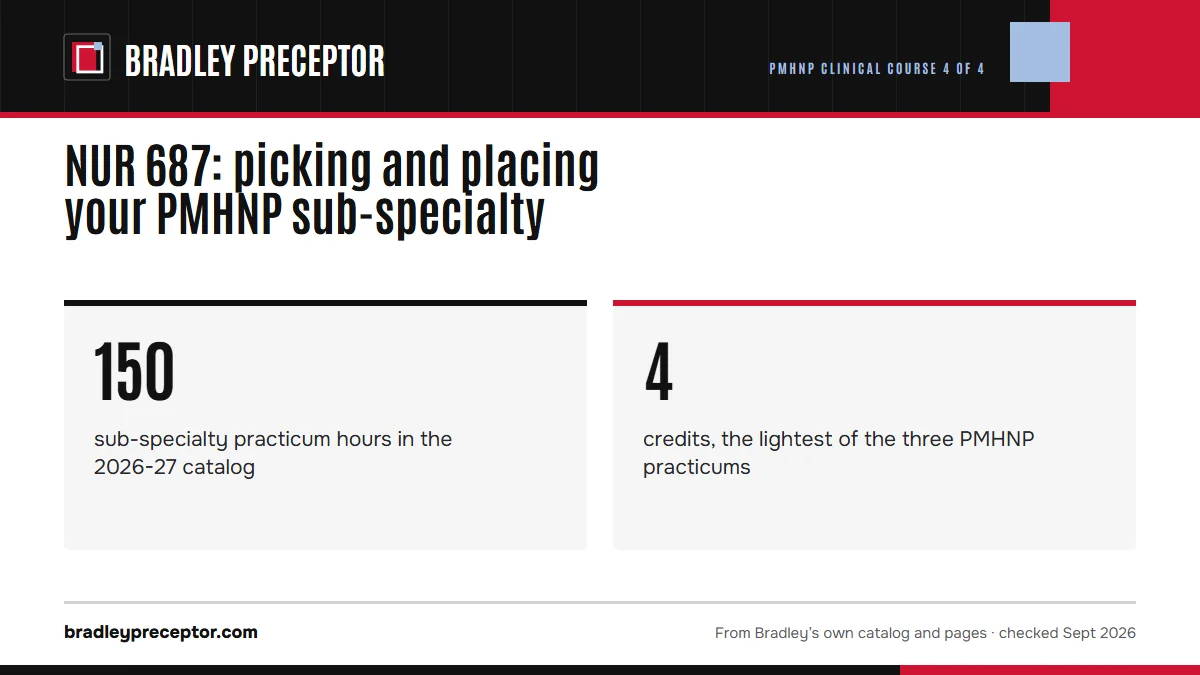
The 2026-27 catalog lists NUR 687 at 4 credits and 150 practicum hours, with NUR 686 as its prerequisite. It is the only PMHNP course that names a setting beyond general psychiatric care: the hours happen in a sub-specialty, and the catalog offers four examples.
Bradley's online PMHNP page calls the course PMHNP Specialty Practicum Focus III. It is the same course; match the catalog title on your packet and your program of study. For BSN-entry MSN and certificate students it brings the PMHNP total to 750, and BSN-to-DNP students continue into project hours afterward.
Like every Bradley practicum, it needs an approved preceptor and facility before hours begin, a clinical agency agreement for the site, and Typhon entries within seven days of each practicum day.
The four sub-specialties Bradley names
The catalog's list opens with "such as", so other focused psychiatric settings may be accepted; clear any alternative with course faculty before you approach a site. Here is what each named option usually looks like day to day:
- Forensics: psychiatric care tied to the legal system, in settings such as correctional health programs, forensic hospital units or court-linked evaluation services.
- Consult liaison: a hospital psychiatry team that sees patients on medical and surgical floors or in the emergency department when mental health questions arise during other care.
- Child and adolescent psychiatry: outpatient youth clinics, inpatient adolescent units, and programs connected to schools or pediatric practices.
- Geriatric psychiatry: geropsychiatric units, memory and cognitive clinics, and consult work in long-term care or assisted living.
Each has its own rhythm. Consult liaison moves fast, with new patients most days; child and adolescent work leans on families and schools; forensic settings layer security procedures over the clinical day.
Choosing the one that fits your plans
Pick the sub-specialty you would most like to practice in, or the one your future employer's patients will need most. The hours are short, so a clear goal helps you ask for the right patient mix from the first day.
Your license and location still narrow the field. You need an active RN license in the state where the site sits, clinicals stay in your approved state, and Bradley's state disclosures list PMHNP as meeting licensure education requirements in 46 states. A consult-liaison service across a state line counts as a bordering-state rotation, which your advisor must hear about before the semester begins.
Certification comes after the program: the catalog names the ANCC and AANP PMHNP exams. The sub-specialty adds depth on top of the general psychiatric range you built in NUR 685 and NUR 686; it does not replace it.
Lead times for sub-specialty sites
Sub-specialty programs take fewer students, and many live inside hospital systems with published student processes. Each system's rules are its own, not an arrangement with Bradley, but they set the pace of your search:
- Advocate Health Care places Illinois inpatient NP students through myClinicalExchange once a school affiliation agreement is in place, asks for two months from request to start, and allows up to three months for a three-way agreement when the preceptor works outside Advocate.
- Northwestern Medicine's north and northwest suburban sites consider applications only from schools with a current affiliation agreement, give priority to their own staff, and quote four to eight weeks for a response.
- Carle Health, which now runs the former UnityPoint hospitals in the Peoria area, uses an online clinical rotation application and says applying is no promise of a spot.
With the NUR 687 packet due by midterm of the semester before, a hospital-based sub-specialty usually has to be settled early in NUR 686. The sites with their own processes page has the detail for each system.
Finishing the PMHNP program
NUR 687 is the last practicum for MSN and certificate students. The MSN PMHNP's comprehensive assessment is the exit exam in NUR 688 Professional Aspects of the PMHNP, a 2-credit course; certificate programs have no comprehensive assessment. Your program of study shows where NUR 688 falls relative to NUR 687; if the two share a term, plan your 150 hours so exam preparation does not collide with your heaviest clinical weeks.
BSN-to-DNP students move on to NUR 841 through NUR 844, the DNP project courses, with a practice mentor; the DNP project hours page covers that stage. The handbook also reminds students that finishing the program is no promise of licensure or certification, one more reason to confirm your state's rules before the final term.
How we place Bradley PMHNP students in a sub-specialty
Tell us the sub-specialty you want, your city and the term NUR 687 starts. We search programs in that niche, confirm which will host a Bradley student for 150 hours, and learn each site's own steps, whether that is a hospital application, an extra background check or a three-way agreement.
We begin while you are still in NUR 686, so the packet is ready for Bradley's midterm date with the preceptor's license, current CV, proof of malpractice coverage and site address in hand. If your first-choice niche has no opening near you, we bring you the closest alternatives the course allows and let you choose.
If a preceptor steps away partway through, we start on a replacement straight away, since this last practicum stands between you and graduation. Use the form below to begin.
Questions Bradley students ask
Which sub-specialties count for Bradley's NUR 687?
The 2026-27 catalog names forensics, consult liaison, child and adolescent psychiatry and geriatric psychiatry as examples. Because the list is illustrative, other focused psychiatric settings may qualify. Get course faculty approval for any setting outside those four before you ask a preceptor to sign the packet.
Can my NUR 686 preceptor also supervise NUR 687?
Only if that preceptor works in a sub-specialty setting that fits the course. The reuse limits come from Bradley's 2017 webinar, and the current PMHNP packet may set different ones. This course is also a good moment to add a new preceptor and a new patient population to your record.
Why does NUR 687 carry only 4 credits?
The catalog simply lists it at 4 credits for 150 hours. Bradley publishes no hours-per-credit rule, and its ratios vary: the 6-credit PMHNP practicums carry 200 and 250 hours, and NUR 684 carries 150 simulation hours for 5 credits. The credit value does not change the 150 hours you owe.
Is PMHNP Specialty Practicum Focus III a different course?
No. That is the name Bradley's online PMHNP page uses for NUR 687. The 2026-27 catalog title is PMHNP Sub-Specialty Focus and Practicum III, and that is the one to match on your DocuSign packet and your program of study.
Do forensic sites need extra clearance?
Bradley's own clearance through Viewpoint Screening covers the background check, drug screen, immunizations, physical and insurance. Individual sites can add their own checks; Bradley's 2017 webinar gave the example of a repeat background check when the Bradley one was more than a year old. Ask each forensic site for its list as soon as it shows interest.
Related pages
Last checked 2026-09-25
We check these pages against Bradley's own catalog, online program pages and Graduate Student Handbook. Your clinical packet, course faculty and academic advisor have the final word.
- Bradley University 2026-27 catalog: NUR course descriptions
- Bradley University 2026-27 catalog: PMHNP post-master's certificate
- Bradley University Online: Psychiatric Mental Health Nurse Practitioner
- Bradley University Department of Nursing Graduate Student Handbook (revised 5/8/2026)
- Northwestern Medicine: student clinical practicum requests, north and northwest
Bradley lets you choose your preceptors. We find the ones worth choosing.
Tell us your Bradley track, your city and your next practicum course. We line up preceptors who fit the NUR course and gather the license, CV and malpractice details the DocuSign packet asks for, well before the midterm of the semester before you start.
- Preceptors matched to the course: primary care for FNP and AGPCNP, acute care teams for AGACNP, mental health settings for PMHNP
- Preceptor license, CV, malpractice coverage and the site address ready for the packet
- Every practicum in your sequence planned together, close to home in your approved state
Start your placement plan
Track, city and next practicum is all we need to begin.