Bradley BSN-to-DNP PMHNP: 750 psychiatric hours plus a practice-change project
Bradley University's BSN-to-DNP in Psychiatric Mental Health Nurse Practitioner pairs the PMHNP clinical sequence with four DNP project courses over about 11 semesters. The catalog sets 750 practicum hours and lets the project courses carry you to the 1,000-hour doctoral minimum. We line up psychiatric preceptors and a practice mentor so neither search holds up the other.
Get your placement plan
Tell us your Bradley program and where you live. A placement advisor replies with the preceptor and site options that fit your course.
The degree at a glance
The DNP PMHNP is BSN entry. It carries the full PMHNP specialty block, seven NUR courses running from the roles seminar through the professional aspects course, the doctoral core shared by Bradley's DNPs plus ECO 605, and the DNP project series NUR 841 to NUR 844, for 72 credits. Bradley's online page estimates 3.7 years across 11 semesters, and the catalog gives doctoral students up to seven years.
The 2026-27 catalog trimmed the program. The 2025-26 version listed 74 credits in its text (73 to 76 in its table) and included NUR 840 DNP Clinical Practice; the current plan drops NUR 840 for the PMHNP doctorate. Board certification runs through the ANCC or AANP psychiatric exam, and the handbook counts your finished DNP project proposal as the comprehensive assessment.
You apply with an accredited BSN, an RN license in good standing and nursing grades averaging 3.0 or better, and the application asks you to discuss possible clinical mentors, so the psychiatric contacts you already have belong there.
Counting to 1,000
The catalog wording is precise: 750 clinical practicum hours across the lifespan, with the hours still needed to reach the AACN minimum of 1,000 completed in the DNP project courses. Bradley's online page simply says 1,000. The course descriptions, added up, give 1,050.
| Course | Hours | Type |
|---|---|---|
NUR 684 | 150 | Clinical simulation with the practicum instructor |
NUR 685 | 200 | Precepted psychiatric practicum |
NUR 686 | 250 | Precepted psychiatric practicum |
NUR 687 | 150 | Precepted sub-specialty practicum |
NUR 841 to NUR 844 | 300 (50, 50, 125, 75) | Project hours with your mentor |
Your plan of study decides how Bradley counts the extra 50. Raise it with your advisor early, and see the DNP project hours page for the comparison across Bradley's doctoral tracks.
Whichever total applies, a psychiatric preceptor covers just 600 of them, assuming NUR 684 remains simulation. The project's 300 hours sit with your mentor, which is why the two searches can run on separate clocks.
Two relationships to build: psychiatric preceptors and a project mentor
The practicum courses need preceptors in mental health settings, each one approved by Bradley together with the site, and each packet sent through DocuSign a semester early, by that term's midpoint. Bradley has published no PMHNP-specific preceptor rules, so faculty and the track's packet decide questions about psychiatrists, psychiatric NPs and how hours are split.
The project courses need a practice mentor, documented in the DNP Project Practice Mentor Packet. Bradley's DNP pages describe projects that change a system or a population's care to improve outcomes, through direct or indirect patient care. In behavioral health that might mean a screening workflow, a follow-up process or a care-transition change; the topic is yours to settle with faculty.
Two project courses lean hardest on the host site. Ethics review happens in NUR 842, through an IRB or Bradley's human subjects committee, and the change itself launches and is measured in NUR 843. A mentor with standing in the organization makes both smoother.
Questions to settle with faculty before you commit
Because Bradley's public material is thin on PMHNP-specific rules, a short list of questions to your course faculty or advisor saves you from a packet that comes back unapproved. Ask them early, ideally before you approach a preceptor at all.
- Can a psychiatrist supervise some or most of your hours, and is there a minimum with a psychiatric NP?
- Does counseling or therapy time count, or only psychiatric evaluation and medication management?
- Do telehealth visits count? The handbook's telemedicine guidelines are named for the FNP and AG tracks only.
- Can one preceptor carry two courses? The 2017 webinar permitted reusing the same clinician, up to twice.
- Is your cohort's
NUR 684simulation, as the catalog says, or precepted, as the online page says?
Bring the answers to your placement advisor and we build the search around them. The NUR 685 page shows how the first precepted course fits.
Sequencing the semesters
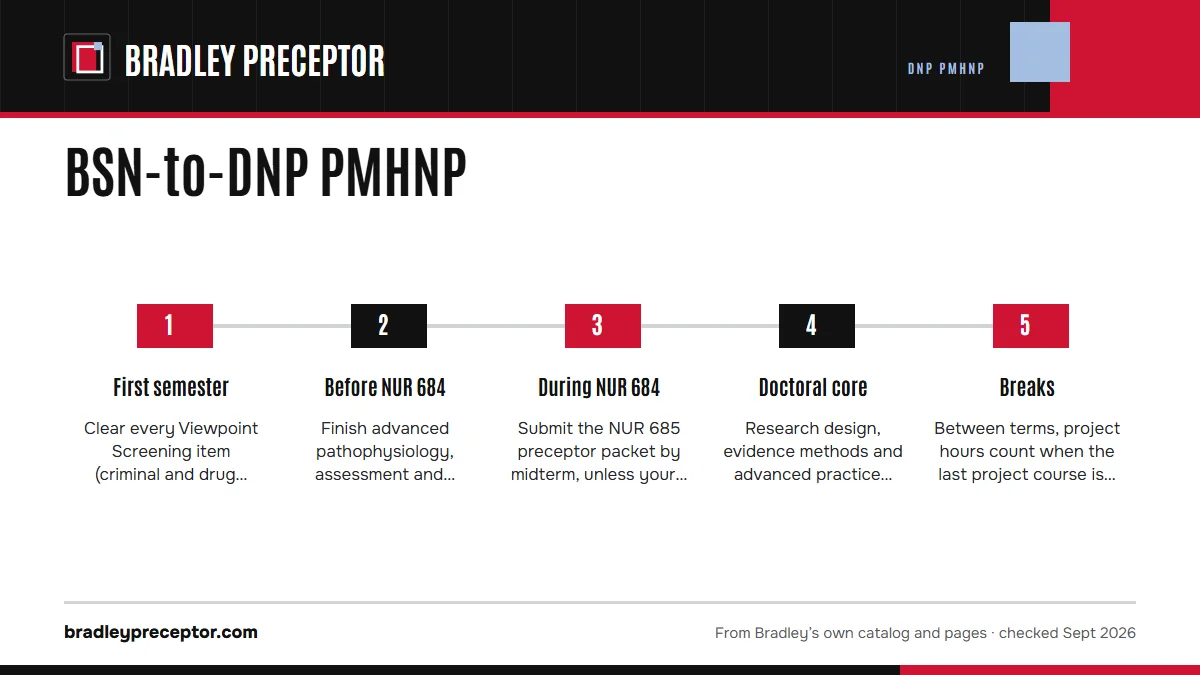
Eleven semesters sounds like plenty of time, but the psychiatric practicums and the project courses overlap, and every precepted course has a packet due a semester ahead. The order below follows the 2026-27 prerequisites.
- First semesterClear every Viewpoint Screening item (criminal and drug checks, vaccines, a recent physical, insurance) before the semester reaches its midpoint.
- Before NUR 684Finish advanced pathophysiology, assessment and pharmacology;
NUR 684then runs with the roles and psychopharmacology courses. - During NUR 684Submit the
NUR 685preceptor packet by midterm, unless your cohort'sNUR 684itself needs a preceptor, as Bradley's online page describes. - Doctoral coreResearch design, evidence methods and advanced practice leadership must be done before
NUR 841, so settle your mentor during them. - BreaksBetween terms, project hours count when the last project course is passed, the next one is on your schedule and your mentor agrees.
The clinical placement process page follows each approval step in order.
Where your practicums and project can be
The PMHNP column of Bradley's state table marks 46 states as meeting requirements and four as not: California, Maryland, New Hampshire and Tennessee. The doctoral footnote reaches beyond clinicals: residents of New York may not base a rotation or a DNP project in their own state, and the District of Columbia is treated the same way.
Practicum and project work stays in your approved state of residence or admission, and a move or a rotation next door needs your advisor's attention before the new semester. An 11-semester degree leaves room for life to change, so read relocating during the program before you sign a new lease.
Wherever you settle, hold an RN license that is valid where each rotation happens; the New York and District of Columbia footnotes also show that Bradley's state rules reach DNP project sites as well as clinical ones.
Why DNP PMHNP students choose us
We plan the psychiatric practicums and the project together. For NUR 685 and NUR 686 we search for mental health practices that see patients across the lifespan; for NUR 687 we find a sub-specialty home, whether forensic, consult-liaison, child and adolescent or late-life psychiatry; and for the project we look for a practice mentor whose organization can host your change.
We check each preceptor's documents before the DocuSign packet goes to Bradley, ahead of each midterm deadline, and confirm the following course during the current one. If anyone steps back, a replacement search opens immediately, and your placement advisor keeps both timelines in one plan so you always know which packet is next. Begin with the form below, or see our process.
Questions Bradley students ask
I already hold an MSN. Is the DNP PMHNP my route?
The DNP PMHNP is BSN entry, and Bradley offers no post-master's DNP in an NP specialty. MSN holders who want the PMHNP role can look at the post-master's PMHNP certificate, which uses the same four clinical courses without the doctoral core and project.
Does the DNP PMHNP include NUR 840?
Not in the 2026-27 catalog. The 2025-26 PMHNP doctorate included NUR 840 DNP Clinical Practice, a variable-credit course for extra practicum hours, but the current plan dropped it and relies on the project courses to reach 1,000 hours. Students admitted under an older catalog year should confirm their own plan.
Can my DNP project happen where I do a practicum?
Bradley's public documents leave this open. The practicum and the project have different paperwork, a preceptor packet for one and the DNP Project Practice Mentor Packet for the other, and different supervisors. If one organization could host both, ask your advisor and project faculty before building your plan around it.
Is there a campus visit in the DNP PMHNP?
Bradley publishes none. The PMHNP is sold as a fully online program without a residency, and this track has no bootcamp in the catalog. Your in-person commitments are the practicum days with your preceptors and the project hours at your mentor's organization.
Where are DNP project hours logged?
Expect Typhon. The handbook gives practicum hours a one-week window for entry, and the project courses describe their hours as practicum hours, so the same routine applies. Hours may not begin before the semester starts and do not count during a leave of absence. Your project course confirms the details.
Related pages
Last checked 2026-09-25
We check these pages against Bradley's own catalog, online program pages and Graduate Student Handbook. Your clinical packet, course faculty and academic advisor have the final word.
Bradley lets you choose your preceptors. We find the ones worth choosing.
Tell us your Bradley track, your city and your next practicum course. We line up preceptors who fit the NUR course and gather the license, CV and malpractice details the DocuSign packet asks for, well before the midterm of the semester before you start.
- Preceptors matched to the course: primary care for FNP and AGPCNP, acute care teams for AGACNP, mental health settings for PMHNP
- Preceptor license, CV, malpractice coverage and the site address ready for the packet
- Every practicum in your sequence planned together, close to home in your approved state
Start your placement plan
Track, city and next practicum is all we need to begin.