Bradley DNP project hours and the 1,000-hour rule
Every Bradley University DNP closes with four project courses, NUR 841 to NUR 844, carrying 300 practicum hours with a practice mentor you propose. For BSN-to-DNP nurse practitioners those hours sit on top of 750 specialty hours, which makes 1,050 against Bradley's stated 1,000. For the post-master's DNP Nursing Leadership they join hours carried over from your master's, with NUR 840 there to close any gap.
Get your placement plan
Tell us your Bradley program and where you live. A placement advisor replies with the preceptor and site options that fit your course.
NUR 841 to NUR 844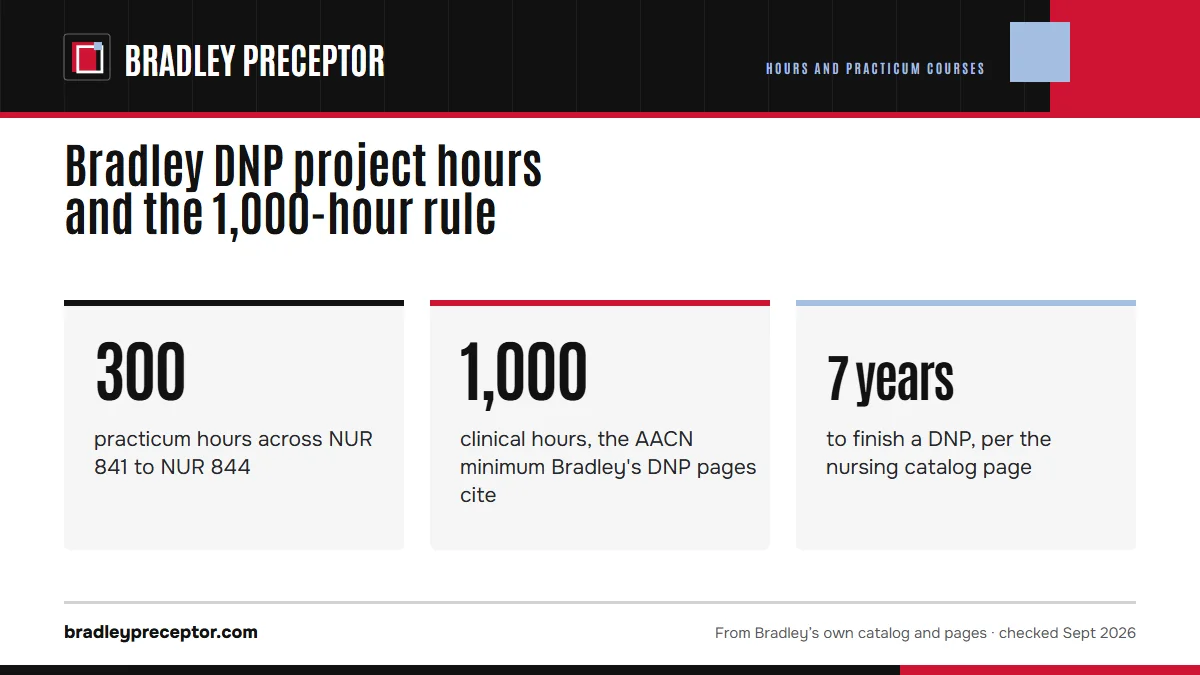
The four project courses, plus NUR 840
The 2026-27 catalog gives each project course a fixed share of the hours, weighted toward implementation in the third course.
| Course | Credits | Practicum hours | What happens |
|---|---|---|---|
NUR 841 DNP Project I | 3 | 50 | Mentor-guided start framed by the AACN Essentials; follows NUR 705, NUR 720 and NUR 735 |
NUR 842 DNP Project II | 3 | 50 | The proposal, including IRB (or Committee on the Use of Human Subjects in Research) approval |
NUR 843 DNP Project III | 3 | 125 | Implementation and evaluation |
NUR 844 DNP Project IV | 3 | 75 | Final paper and oral presentation |
NUR 840 DNP Clinical Practice | 1.0-4.0, repeatable to 15 | Not fixed | The practicum hours still needed to reach the practice doctorate; DNP majors only |
Bradley's DNP catalog pages define the project as a change at the level of a system or a population, aimed at better outcomes whether the patient care involved is direct or indirect. That definition shapes where the hours happen: inside an organization that can host the change you plan to make.
1,000 or 1,050 for nurse practitioner DNPs
The catalog states 1,000 hours for the DNP-FNP, DNP-PMHNP, DNP-AGACNP and DNP-AGPCNP. The AG pages put 750 of those in the specialty and the rest in the project courses; the PMHNP page says whatever is missing toward AACN's 1,000-hour floor is earned in the project courses. Yet 750 specialty hours plus 300 project hours is 1,050.
Bradley's online DNP-FNP page lands on a round 1,000 because it shows NUR 676 with half the catalog's 100 hours. The AG and PMHNP online DNP pages simply say 1,000. Bradley has not explained the gap, so treat each course's listed hours as what your mentor or preceptor should expect, and ask your academic advisor how your total is tallied.
One more 2026-27 change: the AG and PMHNP DNPs no longer list NUR 840, bringing the AG DNP to 68 credits and the PMHNP DNP to 72. The 2025-26 AG DNP had included it at 1.0-4.0 credits. The clinical hours page sets these totals beside every other program.
DNP Nursing Leadership: 300 plus your master's hours
The post-master's DNP Nursing Leadership works from a different base. The catalog requires 300 practicum hours with a practice mentor for the DNP project and credits the clinical hours from your master's degree toward the AACN minimum of 1,000. The admission portfolio asks for your resume and proof of the supervised clock hours you logged in your master's program, so request those records from your previous school early.
If your documented master's hours plus the 300 project hours still fall short of 1,000, NUR 840 DNP Clinical Practice is the course built to make up the difference. The program page shows it at 0.0-14.0 credits, capped at 14, and notes it may not be taken by all students; the course description says 1.0-4.0, repeatable to 15; the online page lists 2 credits. Your advisor sets how much you need, and the handbook lists a separate clinical packet for NUR 840. See the DNP Nursing Leadership page.
Choosing a practice mentor
The mentor search starts at admission. Bradley asks NP DNP applicants to name possible clinical mentors and DNP Leadership applicants to name possible practice mentors for the change they plan to lead, and a Bradley DNP enrollment guide suggests putting potential preceptors in the admission essay. The preceptors-at-application page covers what to list.
The paperwork is the DNP Project Practice Mentor Packet named in the Graduate Student Handbook, and its current version sits in MyOnline. Bradley has not published qualifications for practice mentors, such as degree or years in leadership, so ask your DNP Project faculty mentor before you approach anyone. Keep the two roles straight: the practice mentor guides you at the site, while the DNP Project faculty mentor is Bradley faculty who approves, among other things, any hours over a break.
Choose the organization as carefully as the person. The mentor needs the standing to open doors for your project, and the site needs access to the population or process you plan to change.
Break hours and In Progress grades
Project hours follow a few handbook rules of their own, and they differ from the specialty practicum rules in useful ways.
- Break-time project hours need three things: a passed prior project course, enrollment in the following one, and a yes from your DNP Project faculty mentor.
- Under an In Progress (IP) grade, you may log only what that course still requires.
- The department's Incomplete policy reserves IP grades, normally, for DNP Project courses.
- Every project day goes into Typhon within 7 days, like any other practicum day.
- The nursing catalog page allows seven years from enrollment to finish a DNP; the general graduate regulations say five, so confirm your deadline with your advisor.
For the comprehensive assessment, every DNP track uses the completed final DNP project proposal, per the handbook.
Where the project can run
Project hours fall under the handbook's location rule: clinical work belongs in the approved state where you were admitted or where you now live, and any plan to work across a border has to reach your advisor or the department chair before the semester starts. The welcome sites also tie your RN license to the location, so an active, unencumbered license in the project's state is part of the plan.
Two places carry explicit limits. Bradley's state table rules out both clinicals and DNP projects inside New York for New York students, with the identical restriction for District of Columbia students in DC. If you live in either, settle the project location with your advisor early. The state disclosures page explains the table.
Why Bradley DNP students bring us in
For BSN-to-DNP nurse practitioners, we plan the specialty preceptors and the project organization as one timeline, so your practice mentor is lined up before NUR 841 begins. For DNP Nursing Leadership students, we search out practice mentors, and organizations willing to host, that fit your project topic and can support 300 hours or more, near home and inside your approved state.
We gather what the DNP Project Practice Mentor Packet asks for, keep your hour plan tied to each course's figures, and stay on call if a mentor changes roles mid-project. Where a host organization needs an affiliation agreement, we flag it at the start so Bradley's Office of Online and Distance Education has time to complete it. Bradley approves every mentor and site; we bring it options that are ready. Describe your project through the form below.
Questions Bradley students ask
Who can be my DNP practice mentor at Bradley?
Bradley has not published practice mentor qualifications. Current requirements are whatever the DNP Project Practice Mentor Packet, posted in MyOnline, says, and your DNP Project faculty mentor can tell you whether a candidate fits. The potential mentors you named in your application are a natural starting point; look for someone with authority in the organization where the project will run.
Will hours from my MSN apply to a Bradley DNP?
For the post-master's DNP Nursing Leadership, yes: the catalog credits clinical hours from your master's degree toward the 1,000-hour minimum, and applicants document those hours in their portfolio. The nurse practitioner DNPs are BSN-entry programs, so their 1,000 hours come from the specialty practicums and the project courses.
What is NUR 840, and will I need it?
NUR 840 DNP Clinical Practice is a variable-credit course for practicum hours still needed to reach the practice doctorate. In 2026-27 it appears in the DNP Nursing Leadership course list, which notes that not every student takes it, and no longer in the AG or PMHNP DNPs. Your advisor decides whether you need it and for how many credits.
Can my DNP project run at the organization where I work?
Bradley's public pages do not say. The project needs a setting where you can implement and evaluate a system or population change, with a practice mentor there. Ask your DNP Project faculty mentor, and read the workplace practicum page for how Bradley's rules on paid clinical work apply.
Can New York residents complete the DNP project in New York?
No. A footnote in Bradley's state table keeps New York students' clinical rotations and DNP projects out of New York, and a matching footnote does the same for the District of Columbia. A project site elsewhere must still fit Bradley's license and approved-state rules, so settle the location with your academic advisor early.
Related pages
Last checked 2026-09-25
We check these pages against Bradley's own catalog, online program pages and Graduate Student Handbook. Your clinical packet, course faculty and academic advisor have the final word.
Bradley lets you choose your preceptors. We find the ones worth choosing.
Tell us your Bradley track, your city and your next practicum course. We line up preceptors who fit the NUR course and gather the license, CV and malpractice details the DocuSign packet asks for, well before the midterm of the semester before you start.
- Preceptors matched to the course: primary care for FNP and AGPCNP, acute care teams for AGACNP, mental health settings for PMHNP
- Preceptor license, CV, malpractice coverage and the site address ready for the packet
- Every practicum in your sequence planned together, close to home in your approved state
Start your placement plan
Track, city and next practicum is all we need to begin.