NUR 666: Management of Adolescents, Adults, and Geriatrics I
NUR 666 opens the primary care practicum run in Bradley University's AGPCNP track: 6 credits and 200 clinical hours with a preceptor you find and Bradley approves. Start on the site a full semester early, since Bradley wants the DocuSign packet for this course by the middle of the term that comes before it.
Get your placement plan
Tell us your Bradley program and where you live. A placement advisor replies with the preceptor and site options that fit your course.
What NUR 666 asks of you
Bradley's 2026-27 catalog lists NUR 666 Management of Adolescents, Adults, and Geriatrics I at 6 credits with 200 clinical hours in primary care settings. It is the first of three management courses, followed by NUR 667 at 200 hours and the 300-hour NUR 668.
Every AGPCNP student takes it, whatever the entry point: the BSN-entry MSN (47 credits), the RN-entry MSN (56.5), the BSN-to-DNP (68) and the post-master's certificate (32). The catalog frames the whole track as 750 hours supervised by qualified preceptors in primary care or outpatient practice. NUR 666 supplies 200 of them, alongside the 50 supervised hours built into NUR 655 Diagnostic Reasoning.
The course title names three age groups, and that shapes the site you want. A practice whose panel runs from teenagers through older adults gives you the whole span the title describes. An adult-only internal medicine office is still primary care; if your patient mix is narrow, ask course faculty early whether it covers what the course expects.
Before you can start: prerequisites and clearance
The catalog sets three prerequisites for NUR 666: BIO 526 Advanced Pathophysiology, NUR 651 Advanced Pharmacology I and NUR 600 Advanced Health Assessment. Certificate students who completed those three in the last five years, earning at least a B, may be able to waive them.
Your schedule is built for you from the Program of Study in MyOnline, so whichever term lists NUR 666 is the term your preceptor must be ready. Before the first clinical day, these pieces need to be in place:
- Viewpoint Screening cleared by the middle of your first semester in the program: criminal background, drug panel, vaccine records, a recent physical and proof of health coverage
- An RN license in good standing, with no encumbrance, issued by the state where your practice sits
- Liability coverage, which the Graduate Student Handbook says comes with each practicum course, plus your Bradley clinical badge and a white lab jacket
- Typhon set up: Bradley sends the access details to your B-Mail shortly before your first clinical course, and the account has to be activated within three days
Who can precept NUR 666
Bradley signs off on the facility as well as the person. Its welcome sites add that a preceptor's license must be active and unencumbered, and that an infraction on it can stop approval.
Bradley's fullest public list is dated: a June 2017 webinar aimed at FNP students. It allowed NPs and physicians (MD or DO) to precept, expected NPs to supervise the larger share of hours, and excluded PAs, CNSs and CNLs. That guidance was built for the FNP track, so treat it as background. The AGPCNP clinical packet in MyOnline, which names NUR 666 by number, holds the current wording.
Two rules reach every track. Relatives are off the list, and so is any paycheck for the clinical work itself; both come from the Graduate Professional Behaviors Policy. Nothing public sets a minimum number of years in practice or addresses precepting at your own workplace; the preceptor requirements page sorts what is written down from what is not.
Timeline from packet to first clinical day
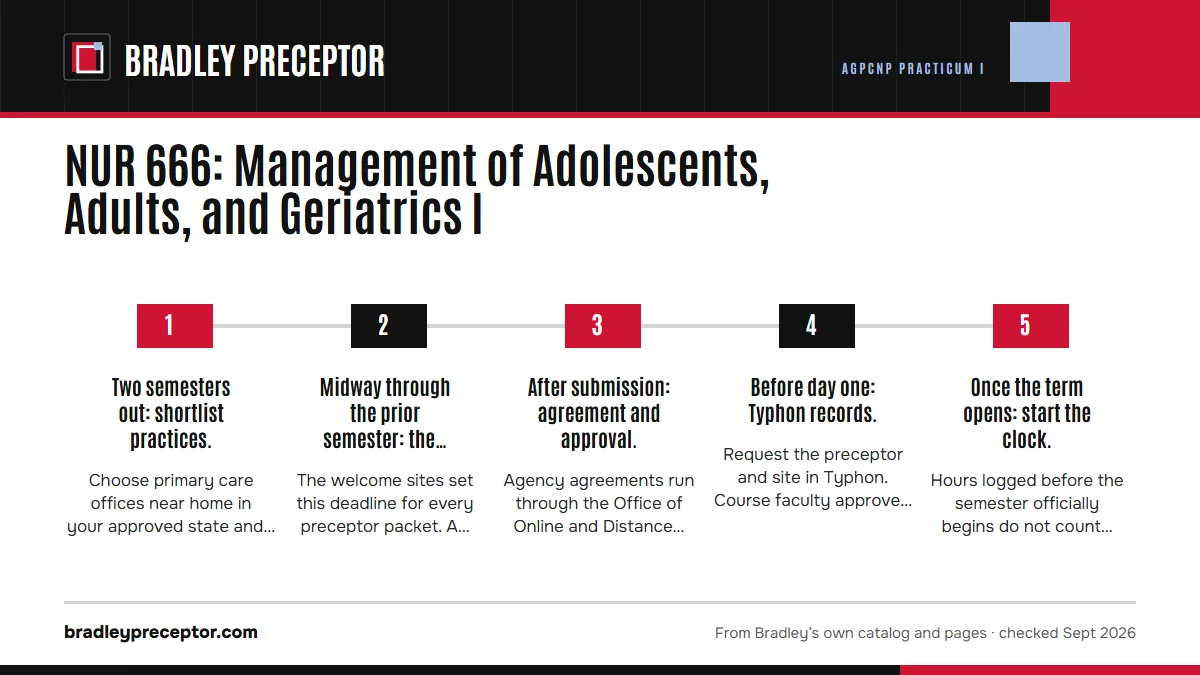
- Two semesters out: shortlist practices.Choose primary care offices near home in your approved state and confirm that each prospective preceptor holds a clean license and can commit to 200 hours.
- Midway through the prior semester: the DocuSign packet.The welcome sites set this deadline for every preceptor packet. A course that opens January 20, 2027, needs its packet in around the middle of fall 2026; the exact day is on the MyOnline calendar. See the preceptor packet guide for the preceptor's side of the forms.
- After submission: agreement and approval.Agency agreements run through the Office of Online and Distance Education. Bradley's 2017 guidance estimated five business days for an approval decision; a health system with its own contract can take far longer.
- Before day one: Typhon records.Request the preceptor and site in Typhon. Course faculty approve the entry, and after that it fills in for later logs (2017 webinar).
- Once the term opens: start the clock.Hours logged before the semester officially begins do not count. Each clinic day, with its patient data, belongs in Typhon inside seven days.
Pacing 200 hours inside a Bradley term
Bradley's public pages leave open whether a 6-credit practicum spans a full semester or one of its half-terms. Your MyOnline schedule settles it, and the semester calendar page has the 2026-27 dates and how the terms divide.
The arithmetic tells you what to ask of a preceptor. Across 15 weeks, 200 hours is about 13 or 14 hours a week, often one long clinic day plus part of a second. Squeezed into 7 weeks, it rises to roughly 29 hours a week. Bradley's 2017 webinar described a typical rhythm of one to two clinic days weekly.
Telehealth is a separate question. The handbook points FNP and AG students to telemedicine guidelines for counting virtual visits toward practicum hours, but that document is not public. Ask course faculty before you build telehealth days into your 200.
Where the catalog and the online page agree, and where they split
For this first course, the catalog and Bradley's online AGPCNP page tell the same story: 200 hours. The gap appears in the totals. The catalog counts 750 for the track (50, then 200, 200 and 300), while the online page still shows 600, with 200 in each management course and no campus residency. The 750-hour change page tracks that shift.
BSN-to-DNP students should note one more line. The catalog's DNP-AGPCNP page places its 750 clinical hours in acute care settings, while every other AGPCNP page says primary care or outpatient. Most likely a drafting slip, yet worth settling with your academic advisor before a site is booked, since an acute care unit and a primary care office are very different placements to arrange.
Why AGPCNP students start NUR 666 with us
Your first practicum sets the pattern for the next two, so we plan all three together. Your placement advisor searches adult and older-adult primary care practices close to home in your approved state, confirms each preceptor will supervise the full 200 hours, and gathers copies of the preceptor's license and CV, proof of malpractice coverage and the practice address for the DocuSign packet.
We work backward from the packet deadline, keep a second practice in reserve in case the first one stalls, and begin the NUR 667 search while you are still logging hours in this course. Approval stays with Bradley; our part is a packet with nothing missing and time to spare. Share your start term through the form below or on the contact page.
Questions Bradley students ask
How many clinical hours is NUR 666 at Bradley?
Two hundred, in the 2026-27 catalog, and the online AGPCNP page shows the same number for this course. They sit inside a 6-credit course and go into Typhon within a week of each clinical day. Nothing counts until the semester officially opens, so build the preceptor's calendar around the term dates posted in MyOnline.
Do I have to finish NUR 655 before NUR 666?
The catalog lists no prerequisites for NUR 655 and names only BIO 526, NUR 600 and NUR 651 for NUR 666, so the two are not formally chained. Your real sequence comes from the Program of Study Bradley uses to register you each term. Check it in MyOnline or with your academic advisor before you book a preceptor's time.
Can one preceptor supervise NUR 666, NUR 667 and NUR 668?
Bradley's current public documents are silent. A 2017 FNP rule capped reuse of one preceptor at two courses, which would rule out one person for all three. Whether that cap survives, and whether it reaches the AGPCNP track, is a question for course faculty and the AGPCNP clinical packet. Settle it before asking anyone to commit to 700 hours.
Do I need an Illinois nursing license for NUR 666?
Only when the practice is in Illinois. Bradley ties your license to the location of the clinical site, and Illinois does not participate in the Nurse Licensure Compact, so a compact license issued by Missouri or Iowa stops at the Illinois line. The clinical state also has to be an approved one: where you were admitted from or where you now live.
What if my NUR 666 preceptor backs out before the term?
Bradley publishes no replacement process, so tell course faculty and your academic advisor at once. Any new preceptor needs a new packet and approval before hours count, and a late start can push back the whole three-course sequence. We run fast replacement searches for students in exactly this spot; the preceptor dropped out page explains how.
Related pages
Last checked 2026-09-25
We check these pages against Bradley's own catalog, online program pages and Graduate Student Handbook. Your clinical packet, course faculty and academic advisor have the final word.
Bradley lets you choose your preceptors. We find the ones worth choosing.
Tell us your Bradley track, your city and your next practicum course. We line up preceptors who fit the NUR course and gather the license, CV and malpractice details the DocuSign packet asks for, well before the midterm of the semester before you start.
- Preceptors matched to the course: primary care for FNP and AGPCNP, acute care teams for AGACNP, mental health settings for PMHNP
- Preceptor license, CV, malpractice coverage and the site address ready for the packet
- Every practicum in your sequence planned together, close to home in your approved state
Start your placement plan
Track, city and next practicum is all we need to begin.