Bradley BSN-to-DNP AGACNP: acute care practicums plus a doctoral project
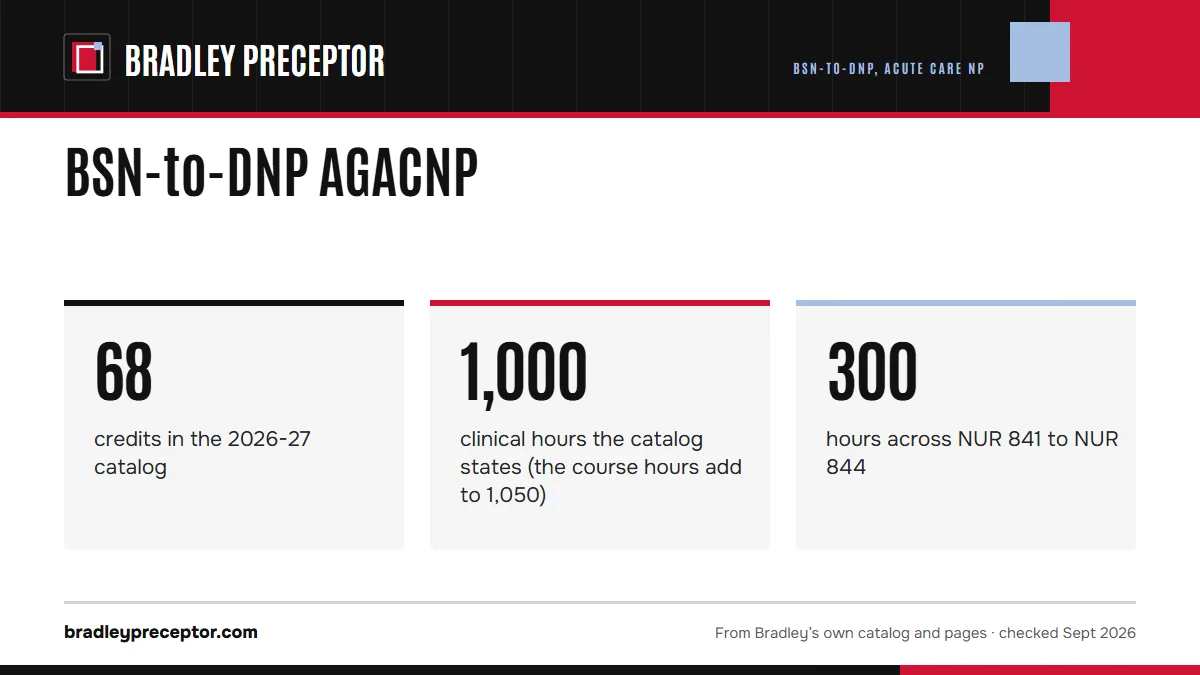
Bradley University's BSN-to-DNP in Adult-Gerontology Acute Care is a 68-credit doctorate that joins the acute care practicums of the MSN to four DNP Project courses. The catalog states 1,000 clinical hours, 750 of them in acute care settings. That means two kinds of supervisor to secure over roughly three years, hospital preceptors and a practice mentor, and our placement desk plans for both from the start.
Plan your DNP AGACNP clinicals
Tell us your start term, city and where you are in the course sequence.
How the 68 credits fit together
The acute care DNP admits nurses with a BSN. Every Bradley NP doctorate starts from the bachelor's, and the one post-master's DNP is in leadership, so this is the only doctoral path into acute care practice at Bradley. The catalog groups the work into five blocks. Its heading on this page reads "Doctor of Science in Nursing (DNP)", a labeling slip that changes nothing about the degree.
Bradley's online page estimates ten semesters, about 3.3 years. The nursing catalog page gives DNP students seven years from enrollment, while the university's general graduate regulations mention five years for any degree, so confirm your own limit with your academic advisor.
| Block | Courses | Credits |
|---|---|---|
| Advanced practice core | BIO 526, NUR 600, NUR 651 | 9 |
| Acute care specialty and practicums | NUR 655, NUR 656, NUR 657, NUR 658 | 21 |
| Advanced nursing practice role | NUR 690 | 2 |
| Doctoral core | ECO 605, NUR 700, NUR 703, NUR 705, NUR 720, NUR 735, NUR 740, NUR 752 | 24 |
| DNP Project | NUR 841, NUR 842, NUR 843, NUR 844 | 12 |
The acute care practicums inside the doctorate
DNP students take the same four acute care courses as master's students: NUR 655 Diagnostic Reasoning with 50 supervised hours, then NUR 656 and NUR 657 at 200 hours each, and NUR 658 at 300. Every one of them needs an acute care setting, and NUR 658 also needs the completed Nurse Practitioner Skills Bootcamp, which the catalog lists for the DNP route as well.
What changes in a doctorate is distance. Specialty courses follow BIO 526, NUR 600 and NUR 651, and in a ten-semester plan the hospital practicums may start well after admission. The course-by-course detail and the bootcamp question are on the MSN AGACNP page; the largest practicum has its own guide. Your recommended sequence sits in MyOnline, and each practicum's preceptor packet has a deadline at the midpoint of the preceding semester.
1,000 or 1,050 hours: reading the totals
The catalog says the program requires 1,000 clinical hours, with 750 in acute care practicums and the balance earned during the doctoral project courses. Add the course descriptions and the figure is higher: 750 specialty hours plus 50, 50, 125 and 75 in the four project courses makes 1,050.
Bradley's online DNP page still shows 1,000 hours overall while labeling the specialty courses at 600 clinical hours, the figure from before the 2026-27 change. The two sources do not line up, and your program of study decides which count you follow. Log every approved hour in Typhon, keep your own running total, and ask your advisor which target your audit uses. Our DNP project hours page sets the conflict out across all the NP doctorates.
Plan for the full course hours, 750 in practicums plus 300 in the project, until your advisor names a different target.
The DNP Project courses and your practice mentor
The four project courses run in order and each carries practicum hours guided by your mentor. Bradley frames the DNP project as a change to a system or a population's care that lifts outcomes, whether your own patient contact is direct or indirect, and the handbook lists a DNP Project Practice Mentor Packet separate from the acute care clinical packet.
| Course | Hours | What happens |
|---|---|---|
| NUR 841 DNP Project I | 50 | Project work with your mentor; comes after NUR 705, NUR 720 and NUR 735 |
| NUR 842 DNP Project II | 50 | Proposal and IRB (or Committee on the Use of Human Subjects in Research) approval |
| NUR 843 DNP Project III | 125 | Implementation and evaluation |
| NUR 844 DNP Project IV | 75 | Final paper and oral presentation |
Finishing the final DNP project proposal is the comprehensive assessment for every Bradley DNP track. A mentor inside a hospital unit you already know well can make the IRB step and the implementation term far smoother.
Project hours over breaks and In Progress grades
Project hours follow slightly looser timing than practicum hours. The handbook lets project hours continue over a semester break when three conditions all hold: the prior project course is passed, you are registered in the following one, and your project mentor agrees. While an IP grade is open, hours beyond what that course still needs are not credited.
Under the department's incomplete policy, IP grades are normally kept for DNP Project courses, and unfinished work must be completed by the date in your contract, with week 11 of the next semester as the outer limit. None of this relaxes the rule for NUR 655 to NUR 658: no acute care hour counts until the semester has formally begun, and each day reaches Typhon within a week.
Mentors named at application, and where the work can happen
Bradley asks every NP applicant to name or discuss possible clinical mentors, and DNP applicants add an essay and a portfolio. A Bradley enrollment guide for the DNP suggests the essay carry a list of potential preceptors. Our application page explains what to list and how it is used.
The catch for a doctorate is time. A trauma NP who agreed to host you when you applied may have changed jobs by the semester before NUR 656, and hospital agreements can take months to set up. Treat the names on your application as a starting list, keep them warm, and confirm each one well before its packet is due.
State rules reach the project as well as the practicums. Footnotes in Bradley's table keep students living in New York or the District of Columbia from completing rotations or the DNP project at home, and the acute care column reads yes in 46 states; see the state disclosures.
How we support Bradley DNP AGACNP students
DNP students pick us because we hold the whole doctoral timeline in view, from the first acute care practicum to the last project term, and adjust it when your unit, your job or your state changes.
- Acute care preceptors for each practicum course, near home and in your approved state
- A shortlist of practice mentor candidates whose setting suits the project you plan
- Credentials from each preceptor (license, CV, malpractice certificate) plus the site address and course, lined up for DocuSign
- Hospital lead times and agreements mapped against the midterm deadline for every term
- Quick cover if a preceptor or mentor leaves partway through a term
Bradley approves every preceptor, site and mentor. We make sure each request arrives complete. Start your DNP placement plan.
Questions Bradley students ask
Does Bradley offer a post-master's DNP for acute care nurse practitioners?
No. Every NP doctorate at Bradley, acute care included, is a BSN-entry program, and the only post-master's DNP is Nursing Leadership. If you already have a master's and want acute care credentials, the 32-credit post-master's AGACNP certificate is the route; our AG certificates page covers it.
Can my acute care preceptor also be my DNP practice mentor?
Bradley's public documents set no rule either way. The two roles use different paperwork, the acute care clinical packet and the DNP Project Practice Mentor Packet, and the mentor guides project hours rather than patient care hours. Ask your DNP project faculty before you plan around one person filling both roles.
Do DNP AGACNP students attend the skills bootcamp too?
Yes. The acute care DNP carries the same single on-site skills bootcamp as the other AG routes in the 2026-27 catalog, and NUR 658 cannot begin in any route until that bootcamp is behind you. Bradley has yet to post AG dates or a venue, so ask your advisor early.
Which certification can DNP AGACNP graduates sit?
The catalog names the ANCC adult-gerontology acute care exam, the same single board listed for the MSN and the certificate. Your state board of nursing then decides licensure, so check the acute care column of Bradley's state table for the state where you plan to practice.
Related pages
Last checked 2026-09-25
We check these pages against Bradley's own catalog, online program pages and Graduate Student Handbook. Your clinical packet, course faculty and academic advisor have the final word.
- Bradley University catalog 2026-27: DNP AGACNP
- Bradley University catalog 2026-27: NUR course descriptions
- Bradley University Online: AGACNP program page
- Bradley University Department of Nursing: Graduate Student Handbook (rev. 5/8/2026)
- Bradley University: Graduate Course Extension and Incomplete Grade Request policy
Bradley lets you choose your preceptors. We find the ones worth choosing.
Tell us your Bradley track, your city and your next practicum course. We line up preceptors who fit the NUR course and gather the license, CV and malpractice details the DocuSign packet asks for, well before the midterm of the semester before you start.
- Preceptors matched to the course: primary care for FNP and AGPCNP, acute care teams for AGACNP, mental health settings for PMHNP
- Preceptor license, CV, malpractice coverage and the site address ready for the packet
- Every practicum in your sequence planned together, close to home in your approved state
Start your placement plan
Track, city and next practicum is all we need to begin.