California and Bradley University's online NP tracks
Bradley University's state table clears only its online FNP for California, and that YES carries a footnote about Schedule II prescribing. The PMHNP, AGACNP and AGPCNP read NO, so none of those three is a path to NP licensure in California. For FNP students, the bigger task is California's own approval rule for NP programs based in other states.
Get your placement plan
Tell us your Bradley program and where you live. A placement advisor replies with the preceptor and site options that fit your course.
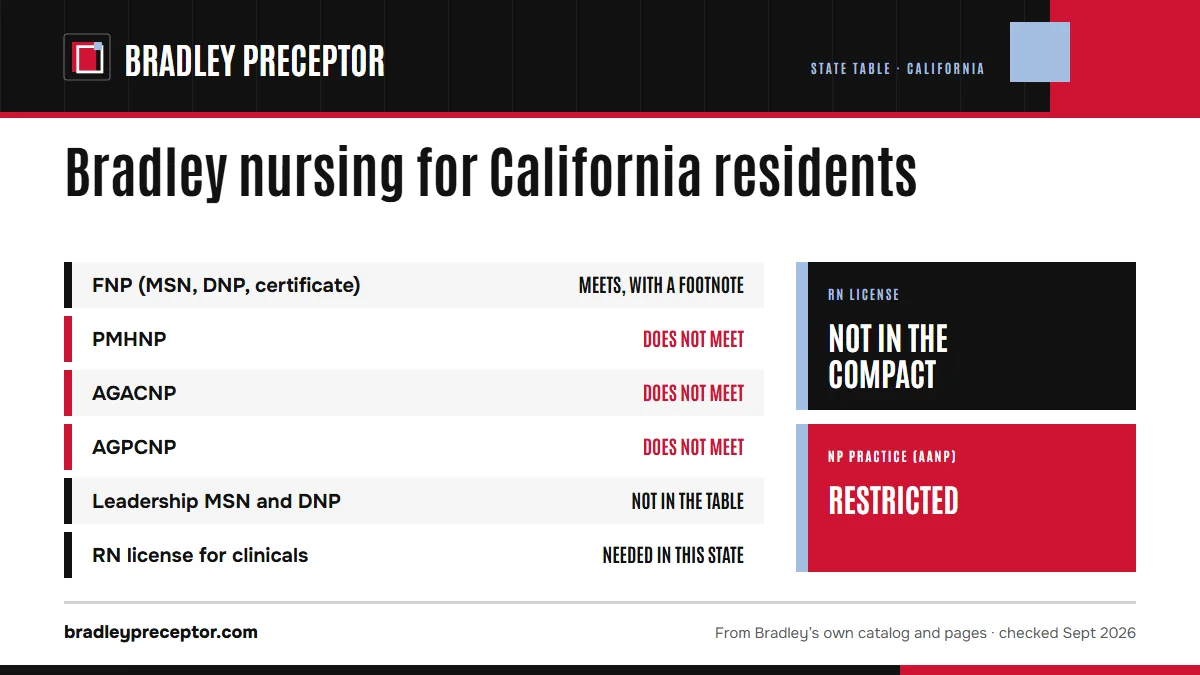
Bradley's California row, cell by cell
Bradley links its online nursing table, Authorization by State - Nursing, from its State Disclosures page. The document carries no date, so reread it before you apply and again before each clinical year. California is one of four states where Bradley's NP specialties split apart.
| Bradley program | Answer for California | Note |
|---|---|---|
| Family Nurse Practitioner | Meets (YES*) | Footnote on Schedule II pharmacology |
| Psychiatric Mental Health NP | Does not meet (NO) | No path to licensure here |
| Adult-Gerontology Acute Care NP | Does not meet (NO) | No path to licensure here |
| Adult-Gerontology Primary Care NP | Does not meet (NO) | No path to licensure here |
| MSN Nursing and Healthcare Leadership | Not listed | Left out of the table |
| DNP Nursing Leadership | Not listed | Left out of the table |
The table never separates the MSN, DNP and certificate, so each column appears to speak for every level of its specialty. The state disclosures guide reads the whole table.
What the Schedule II footnote asks of FNP graduates
The asterisk on California's FNP cell points to a two-sentence note. Bradley says its advanced pharmacology course falls short of California's Schedule 2 controlled substance requirements, and that a graduate whose employment setting calls for Schedule II drugs completes a supplemental three-hour course approved by the state board.
The note names the board as CASBON and SBON; the agency itself is California's Board of Registered Nursing, the BRN, whose site lists the courses that qualify. The trigger is your future job, not your clinicals, so ask an employer early whether the role involves Schedule II prescribing, and fit the course in once NUR 679, the 300-hour immersion that closes the FNP sequence, is done.
California screens NP programs from other states
California regulates visiting NP programs head on. Its rule for them, 16 CCR 1486, makes a nurse practitioner program based in another state win the BRN's approval before any of its students train at a California site. That program has to meet NONPF and AACN standards, use preceptors the Board accepts, and cover California NP law in its teaching, with the standardized procedure rules among the topics.
The school applies, not you. Bradley would file the Board's Verification of Clinical Practice Experience form, wait for a vote at a Board meeting, and then keep an NP Program Preceptor form on each preceptor it uses in California. Bradley's public pages are silent on whether its FNP holds this approval, so settle it with your academic advisor or the Office of Online and Distance Education before you approach a California site.
Your preceptor falls under the rule too, holding a California license in their own discipline and qualified in your NP specialty; the school orients each one, faculty review them on a two-year cycle, and a signed agreement with the clinical agency defines the role. Bradley's standards on the preceptor requirements page apply on top.
License, practice rules and where to look
No compact bill is pending in Sacramento, and California stays out of the Nurse Licensure Compact, so a multistate license from any other state ends at the California line. Subsection (d) of 16 CCR 1486 has students of out-of-state NP programs hold a current California RN license before clinical hours there, in step with Bradley's rule on the RN license page. California also certifies an NP only on top of that RN license, so open the BRN application early.
AANP rates California as restricted: some settings and procedures keep an NP under a standardized procedure agreement, with exemptions the BRN explains. Most Californians live around Los Angeles, the Inland Empire, the Bay Area and San Diego. Kaiser Permanente, headquartered in Oakland with regions north and south, the six academic centers of UC Health, Sutter Health in the north and Central Valley, Cedars-Sinai and Stanford are names to orient a search; no Bradley source lists them as partner sites.
Why California FNP students choose us
Your placement advisor starts where California starts, by making sure Bradley has cleared California sites for your course. Then we find FNP preceptors near you with active California licenses, collect every document Bradley's DocuSign packet asks for and deliver it complete, well before the midterm deadline of the semester ahead of your course, while we line up the practicum after it. When a preceptor steps away, we are already calling the next one. Tell us your city and next course on the contact page.
Questions Bradley students ask
Can I do Bradley's PMHNP or an AG track while living in California?
Bradley's table marks the PMHNP, AGACNP and AGPCNP as not meeting California's education requirements, so none of them leads toward NP licensure in California. Whether Bradley admits California residents to those tracks is unpublished; ask admissions and keep the reply before you invest in an application.
Is the Schedule II course part of Bradley's FNP curriculum?
No. Bradley's footnote describes a supplemental three-hour course, approved by the California board, that a graduate completes when the job requires Schedule II prescribing. It sits outside Bradley's FNP course list, so budget time for it near graduation.
Can I count FNP hours from a site in Arizona, Nevada or Oregon?
Only with a green light from your academic advisor or the department chair before the semester, because Bradley treats any rotation across a state line as a special case. You would also hold an RN license for that state. Arizona's board, for example, must approve an APRN program from elsewhere before its students do clinicals in Arizona.
Do Bradley's leadership degrees work for California nurses?
Neither leadership program appears in Bradley's state table, and Bradley's online DNP Nursing Leadership page describes that degree as not built to lead to licensure or certification for a particular profession. Send California enrollment questions about either one to the Office of Online and Distance Education.
Related pages
Last checked 2026-09-25
We check these pages against Bradley's own catalog, online program pages and Graduate Student Handbook. Your clinical packet, course faculty and academic advisor have the final word.
Bradley lets you choose your preceptors. We find the ones worth choosing.
Tell us your Bradley track, your city and your next practicum course. We line up preceptors who fit the NUR course and gather the license, CV and malpractice details the DocuSign packet asks for, well before the midterm of the semester before you start.
- Preceptors matched to the course: primary care for FNP and AGPCNP, acute care teams for AGACNP, mental health settings for PMHNP
- Preceptor license, CV, malpractice coverage and the site address ready for the packet
- Every practicum in your sequence planned together, close to home in your approved state
Start your placement plan
Track, city and next practicum is all we need to begin.